‘Love can open any door and maybe
If you trust in me, I can make you see.’
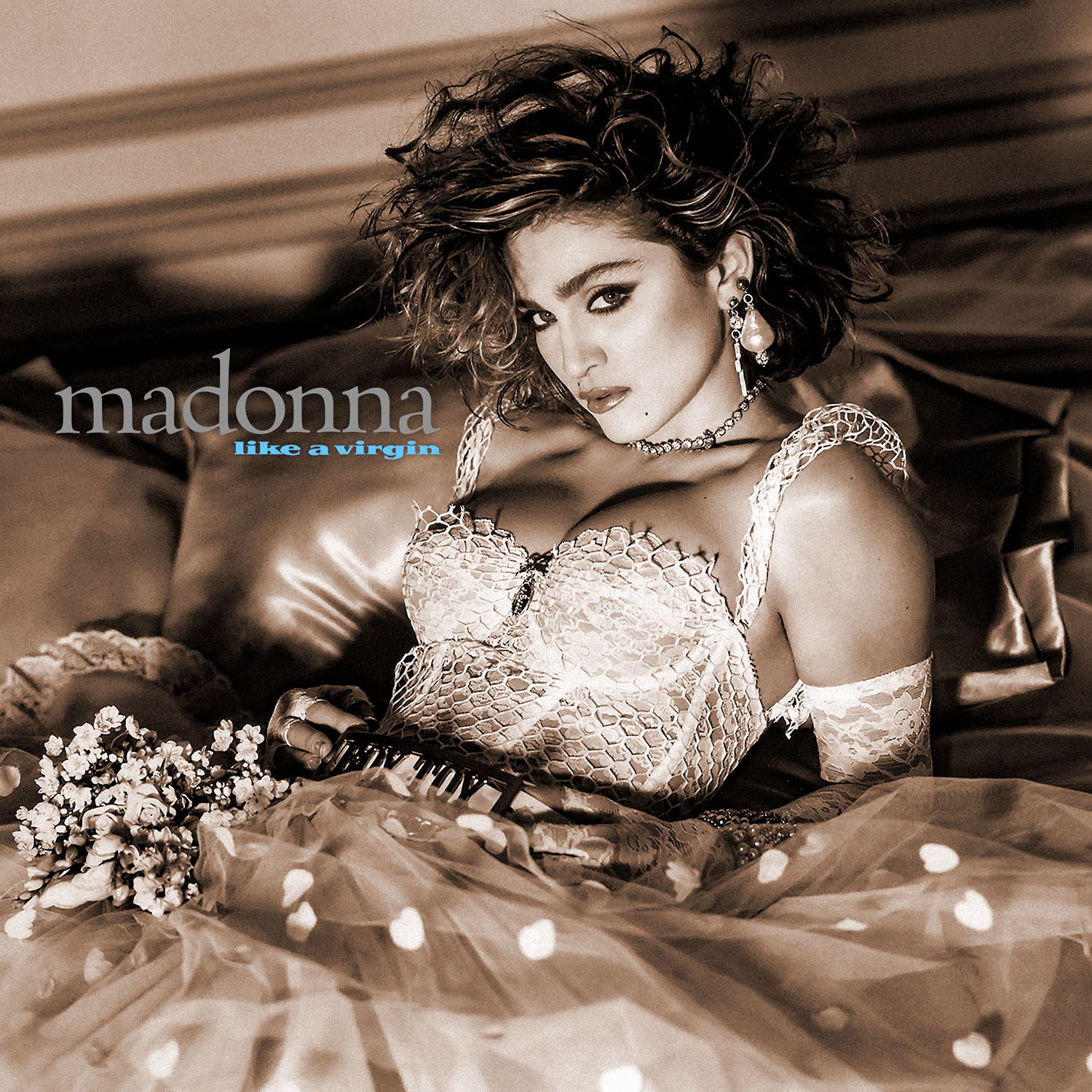
As well as Madonna (vocals) there’s a lot of musicians on this album, but for the angle of this piece I am looking closely at the presence of Chic in the form of Nile Rodgers (producer/ guitar), Bernard Edwards (bass), Tony Thompson (drums) and Rob Sabino (keyboards).
Madonna was aiming to build on the slow-burning success of her self-titled debut album which took a year to reach its peak of number 8 in October 1984 on the US album chart. Three of the singles from it – Holiday, Lucky Star and Borderline – did well in charts world-wide helping to push the album to the top. It’s noticeable that Curtis Hudson (on Holiday) and Paul Pesco (on Lucky Star) both sound uncannily like Nile Rodgers!
Madonna’s style at this point was focussed on dance music tunes with strong melodic hooks and polished arrangements. Stephen Erlwine’s ‘Madonna Overview’ on Allmusic (2012) claimed, with some justification, that the album had a ‘huge role in popularizing dance music as popular music again.’ The album, like Madonna at that time, had an unaffected charm. The Quietus‘ Matthew Lindsay, later perceptively called it one of the singer’s best and a ‘simple soundtrack to complicated times.’
Staying with that would have seen her run out of steam and she was keen to move on. She outlined to MTV in 1984 what had attracted her to work with Rodgers: ‘I think he embodies a lot of different styles that my music embodies. He’s very close to the black sound, funk. I mean the stuff he did with Chic, Sister Sledge and Diana Ross is just phenomenal, but he’s also made a lot of great pop records with David Bowie, Duran Duran and INXS.’ Another positive of working with Rodgers was it would mean working with stellar studio musicians. There’s nothing wrong with the playing on her debut but who can recall the musicians’ names?
Rodgers recalled in his autobiography (Le Freak) that the first time Madonna played him her demos, she misunderstood his quiet attentiveness as a lack of appreciation. She told him: ‘If you don’t love all of these songs, we can’t work together.’ Thinking quickly, he replied, ‘Well, to be honest with you, I don’t love all these songs, but I can promise you this – by the time we’re finished with them, I will!’ She was impressed and reassured, telling MTV : ‘As soon as we met, we hit it off really well and we thought it would be a great union.’
Three key songs by outside writers were suggested by Michael ‘Mo’ Ostin (Warner’s A&R). The two new songs he felt were ideal were Material Girl and Like A Virgin. Ostin’s other inspired suggestion was a cover of the iconic Rose Royce song Love Don’t Live Here Anymore.
Rodgers got down to work with Madonna. He revealed to Sound On Sound (April 2005): ‘I told her that her first album was brilliant, but it was so electronic and technical that the subliminal artistry of Madonna didn’t come through. I thought that if she made a more organic record, even though it was a dance/pop record, people would relate to her artistry in a way that would be astonishing. And she trusted me and went for that.’
Despite one oft-reported occasion when she berated Edwards for turning up late, it seems Madonna was happy with the recording sessions and was grateful to Rodgers in particular, as she asserted to MTV : ‘We just have a really good chemistry and he understands my musicality. He’s a trained musician and I’m not really. I don’t know musical terminology; he can just read my mind. He’s very sensitive; I think he could work with anyone who’s good.’
Like A Virgin was the last major co-operative effort by the Chic Organisation, featuring Rodgers, Edwards, Thompson and Sabino all together on Material Girl, Like A Virgin, Love Don’t Live Here Anymore and Shoo-Bee-Doo.
Thompson saw the writing on the wall for Chic, as he made clear to One Two Testing in 1985: ‘In the end, it got to be too candy-coated and I was really frustrated with the whole thing. Nile was bringing in a lot of drum machines and playing them to death.’
Like A Virgin was in fact the first album on which Rodgers used the Synclavier, an instrument he would be most enthusiastic about, sadly to the detriment of his guitar playing. Sabino, too, used the Synclavier, but for the most part, stuck to a Sequential Circuits Prophet 5, as well as Fender Rhodes and acoustic piano (the latter most effectively on Shoo-Bee-Doo).
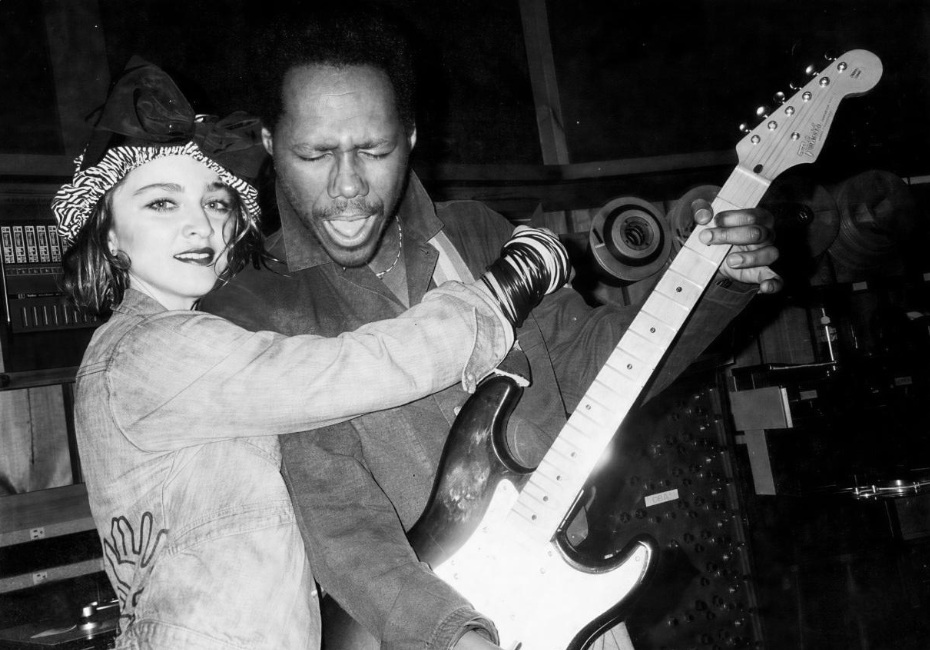
When the first single was discussed, Rodgers felt Material Girl was the obvious choice. But the consensus of opinion (including Madonna’s) was that Like A Virgin was the one. I think Rodgers’ instincts were right. Either way, both songs were enormous hit singles, as was the album, which remains Madonna’s biggest seller (aside from The Immaculate Collection compilation).
Four huge hit singles from the album helped maintain growth, as did two absolutely superb non-album singles in Crazy For You and Into The Groove.
As the album was originally sequenced, it fades in quality after Shoo-Bee-Doo. If you took out the last two tracks and swapped in those two non-album singles, this would have been an even bigger hit record. Of course, Into The Groove was added to the 1985 international reissue, where it opened side two with its effervescent earworm pop.
The irony was not lost on Rodgers that basically the same sound they had been pushing with Chic, without much recent success, was now number one with Madonna fronting it. Like A Virgin has several golden songs, including some stunning Chic Organisation highlights.
The Songs
Material Girl. This was a good fit for Madonna, whose phrasing makes the most of the tongue-in-cheek lyrics. In Le Freak, Rodgers outlined Madonna’s comfortable range as between alto and mezzo-soprano, so there were challenges when she opted to go higher, in particular on Material Girl. She sings it in a range from mezzo-soprano up to B-flat, above her comfort zone, and with what Rodgers described as a ‘nasal quality’.
Thompson’s huge, punchy drums open the song. Edwards’ strong bassline is simple, clear and catchy, which is a fair summary of the verses, too. Edwards only alters his part for the choruses, where his lines are busier, as is the chorus itself. It’s a great example of playing for the song. The melody comes from Rodgers on Synclavier and synth. He gets an almost Bontempi organ sound here that adds a kitsch element.
Madonna is simply sensational, her personality shines through and she gives the lyrics her all. She adds her own harmonies to the mix in the chorus for added effect. The contrasting backing and harmony vocals of the Simms brothers and Curtis King are equally well done, especially their deadpan chorus singing.
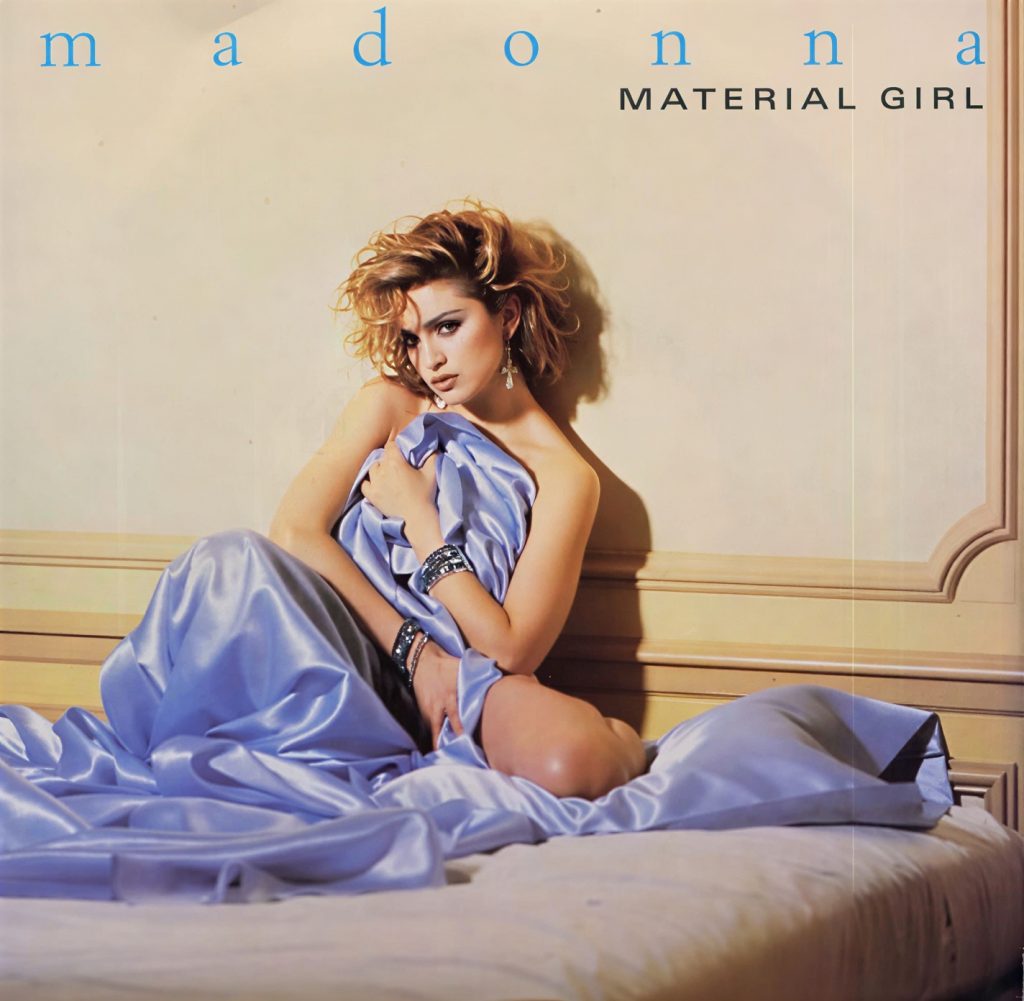
While this is not especially a ‘Chic’ song, it shows how well the ensemble can slip into a different style. This thoroughly uplifting and joyous song was the second single from the album and went all the way to number three in Britain and number two in America. Watch the promo for Material Girl
Angel. The single did well, reaching number five in Britain and America. It’s one of the oldest songs on the album and you can hear the links back to her debut quite clearly in its sound and construction. It isn’t one of the best tracks, being somewhat repetitive; Madonna has little to work with to give the song extra zip.
It features the alternative core band of Rodgers, Sabino and Jimmy Bralower. Bralower’s drum programming is great for the song, but you have to say that Thompson would have been better and less mechanical. Credit to Sabino, who carries all the melody lines and chords on his synth. Rodgers is there, too, doubling him on guitar, but for some reason, he’s too low in the mix. When he becomes more audible from 2:26, his guitar adds more life and colour. The outro is the best part of the song, when his guitar finally gets to shine.
Like A Virgin. Rodgers explained to Howard Massey of Behind The Glass (2000) that: ‘If you look at the track sheet, you’ll see that there aren’t very many tracks used. It’s just bass, drum kit, one guitar, keyboard pad, one keyboard overdub and Madonna’s vocal, plus one other vocal with Madonna to double herself in the chorus only – that’s it.’
It’s a tricky song vocally for Madonna in the key of F#, which was a stretch for her. But she pulls off a piece of performance art, inhabiting the character at the heart of the lyrics. Now I know this song is immensely popular, but it doesn’t do much for me. Lyrically, it leaves me cold with references to ‘touched for the very first time’ and ‘been saving it all for you’. I think it’s the youthful quality in her vocal that I find hard to take when put with those lyrics and others. Musically, I think it lacks a significant uplift in the chorus. I think it could have been much bigger.
Looking at it from a Chic fan’s viewpoint there’s not much about it that reminds me of Chic, in spite of Rodgers, Edwards, Thompson and Sabino all playing on it. But it was an enormous single, hitting number one in America and many other countries, so it certainly struck a chord with millions of people. It reached number three in Britain, stalling behind the Christmas offerings from Band Aid and Wham!
Over And Over. This punchy track is driven by Bralower’s exciting, crashing drum programming, which works well alongside great melodic work from Sabino and Rodgers. The latter’s chord work is sublime, his guitar chiming through the mix.
Madonna, meanwhile, commands your attention with a confident, assertive vocal. It’s a very simple song – musical fast food – but it’s also frothy and fun. It’s a catchy little gem that never fails to win me over.
Love Don’t Live Here Anymore. This is a brave cover version. Madonna was well up for the challenge, and she recorded it live with the strings and band. She acquits herself well, although her voice isn’t as soulful as Gwen Dickey on the original. What she does do well is communicate this story of a relationship ending, left now with ‘Just emptiness and memories.’ She imbues it with hurt and anguish.
Stay. This is not the finish the album needed; it’s a B-side at best. There’s a positive feel to it, especially in Madonna and the backing singers’ vocals, but the backing track just plods along. It means that the verses in particular never quite come to life. So it leaves the chorus with a lot to do to pick this one up, and it could have been a song you remember almost entirely for the chorus. But this chorus can’t manage that. They should have replaced this one on the running order.
Credit also to Rodgers, whose finely detailed string arrangement is immense. Every note is the perfect accompaniment and reaction to Madonna.
Dress You Up. Rodgers approached songwriters Andrea LaRusso and Peggy Stanziale to write a song for Madonna in the Chic style. Why he didn’t come up with something himself is a matter of conjecture, but this is a great slice of pop music, nonetheless.
The bridge section at 1:19 reminds of the one in Into The Groove, in the way that she slides into it with a more conversational tone, and the melody also has a similar feel. It’s a really good section, and it’s a little of a dip when the chorus comes in after it. Luckily that bridge section is repeated at 2:27, this time with a post-script about ‘his’ lying. The outro of more choruses and an instrumental fade of the chorus melody is way too long.
The two verses are strong, with nice details in the lyrics giving Madonna scope for nuances and inflections, such as the delicious ‘feel the silky touch of my caresses’. But this is all about the big choruses, which really sell it. Chic fans can enjoy some funky licks from Rodgers, most noticeably in the choruses. He also delivers a piercing rock guitar solo at 2:01. It’s extra unusual for him as he uses the tremolo arm for effect, which he usually shies away from.
Shoo-Bee-Doo. The only solo write on the album for Madonna is the big one for Chic fans, with a strong yet vulnerable vocal performance – she handles it so beautifully. It’s a gorgeous, reflective song in the verses, especially the wistful opening verse, where she sings purely accompanied by Sabino’s piano and what sounds like a string synth.
From there, it picks up with a sweet, understated swing to the verses. But when Madonna hits the chorus, it’s like grey rain clouds have cleared and the sun has come out. It’s simply magical as Rodgers’ guitar comes in loud and clear and all is right with the world.
In the rhythm section, Edwards and Thompson keep it clean and direct, but there’s an organic feel to their playing, without the noise of the Synclavier, etc., that lets this song breathe without clutter. There’s also a great sax solo from Lenny Pickett for the added icing on the cake. He also plays over the outro. This gem is an outstanding song for Madonna and Chic fans. Listen to Shoo-Bee-Doo
Pretender. After what seems a long 18 second intro Madonna comes in with the chorus and it proves to be weak and unmemorable. The verses are better – a stronger melody than the chorus and Madonna sounds better singing alone. The backing on the verses sees Sabino carrying the melody and Rodgers on rhythm plus what is otherwise an electronic backing track. On this occasion the backing track doesn’t particularly work, whereas it does, for example, on Over And Over or Dress You Up where you don’t miss the ‘real’ instruments so much.
(This piece is edited from the longer version in my book on The Chic Organisation.)