‘Do you feel like you ever want
To try my love and see how well it fits
Baby, can’t you see when you look at me
I can’t kick this feeling when it hits‘
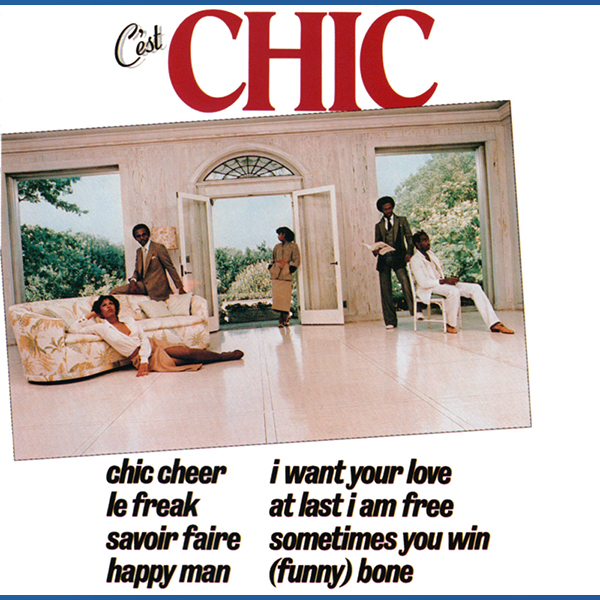
Nile Rodgers: guitar, backing vocals. Bernard Edwards: bass, lead vocals on ‘Happy Man’ & ‘Sometimes You Win’. Tony Thompson: drums, percussion. Alfa Anderson: lead vocals on ‘Le Freak’, ‘I Want Your Love’, ‘At Last I Am Free’ and ‘Sometimes You Win’, backing vocals Diva Gray: lead vocals on ‘Le Freak’, backing vocals Luci Martin: vocals Sammy Figueroa: percussion Ray Jones: Fender Rhodes, keyboards Rob Sabino: clavinet, electric piano, acoustic piano on ‘Le Freak’ Andy Schwartz: piano on ‘At Last I Am Free’ Cheryl Hong, Marianne Caroll, Karen Milne: the Chic strings Gene Orloff: concert master Jose Rossy: tubular bells on ‘I Want Your Love’ Jon Faddis & Ellen Seeling: trumpet Jean Fineberg & Alex Foster: saxophone Barry Rogers: trombone. Produced & arranged by Rodgers & Edwards.
Following the success of their debut album, Chic, and the two singles from it – Everybody Dance & Dance, Dance, Dance – it was time to record another album. It saw the band sharpening their sound and style. C’est Chic is a more cohesive record with strong material and added gloss with the strings and brass.
The band had broken off from touring to lay down material in the studio. Former singer Norma Jean Wright doesn’t appear in the credits, which is puzzling because when talking to Classic Soul (November 1978), she said that she was ‘finishing off the second Chic album (C’est Chic) and doing background work on a Sister Sledge album (We Are Family), which Nile and Bernard are producing.’
But in better vocals news C’est Chic sees the start of the dream team – Alfa Anderson and Luci Martin. The duo spoke to Wax Poetics (summer 2015). Anderson described her Chic vocal sound as piercing, clear and smooth, adding that ‘I didn’t have what people thought of as a heavy soulful voice.’ Martin revealed that she started her singing career accidentally when she auditioned for Hair: ‘I was going to be a chorus girl, dancing. My ambition wasn’t to be a singer. The producers asked me to do Aquarius, liked it, and I got the job.’
Martin then recalled how she was recruited for Chic while at a party attended by Rodgers, Edwards and Thompson. ‘I knew Tony from Queens, and we joked about the neighbourhood the whole time, until Nile asked me if I’d heard Dance, Dance, Dance. No, disco wasn’t my thing.’ It was then that Martin hit them with a curve ball, telling Rodgers and Edwards that one of the notes in the ‘ba-ba-ba-ba’ section was incorrect – ‘if you’re following the chord, the next note should be a half-step down.’ The trio left the room, returned, and told Martin that she was in. ‘In what?’ she asked!
Percussion-wise, Sammy Figueroa is retained as the main man, fully involved in the rhythm tracks. He told me: ‘Tony (Thompson) and I were really good friends. I was so used to doing studio work that they trusted my instincts and how I felt about what to play. They never told me what to do; there was nothing written for percussion. Nile never said, ‘I want you to play a shaker’ or whatever. He just said, ‘Go in there, do whatever you want.’ So I did whatever felt right on each track.’
‘I would sometimes say, ‘Hey, I don’t feel that this song needs percussion, just keep the groove as it is’. And they would be shocked when I said that, but they knew that my instincts were right. My whole thing was just to make the groove bigger. Most of the time, I would create a rhythm with just woodblocks, tambourine and a cowbell. Tony Thompson would be playing a groove, and for me, it was about enhancing the groove rather than overindulging in your ego.’
Figueroa also commented on Rodgers and Edwards’ style in the studio: ‘They worked together perfectly. Bernard was the one who had that master-groove thing; he was the one who laid down the foundation with his basslines. Nile is a rhythm guy, you know, not especially a soloist like a blues guitar player like Stevie Ray Vaughan. That groove Nile plays on the songs made them famous. Now, everybody copies those lines.’
I Want Your Love was nearly not recorded by Chic. The original intention was to record He’s The Greatest Dancer, with Sister Sledge getting I Want Your Love. The decision was reversed, although Kathy Sledge has claimed she can still hear their voices on the backing vocals of I Want Your Love. In fact, both albums (C’est Chic and We Are Family) were recorded at the same time! The basic tracks for both albums were recorded in Studio B at Power Station (New York) over four days, while the string and brass overdubs were recorded in the larger Studio A.
The challenge of recording two albums with the same crew of musicians meant punishing round-the-clock schedules for Rodgers, Edwards and the core band. They worked fast; it is known that Le Freak’s backing tracks (guitar, bass, drums and keyboards) were done in just two hours! Three keyboard players are credited overall on the album. It hasn’t been explicitly stated how the contracts were worked out, but Andy Schwartz (real name Andrew Barrett) was definitely hired as a session player, behind Sabino and Jones.
The importance of strings to the Chic sound was firmly endorsed for this album with the arrival of the celebrated Chic strings which are such an asset to the arrangements. Also arriving, for a shorter run, was a brass section.
The brass players recorded their parts for four albums in one session! Jean Fineberg told me that, ‘The strings were recorded completely separately from the horns in the studio. We had the charts, but very little was known. Just go into the studio, play this and play that. Nile and Bernard might say, ‘Oh, play this note shorter or don’t play this note.’ I don’t know if we even knew the names of the tunes or what the album was going to be called. But the horn lines were fun to play; they were good lines.’
Fineberg and her partner Ellen Seeling had originally joined Chic for the tour promoting the first album. She explained: ‘We were definitely musicians for hire. I am sure they had the plan in their heads, but they didn’t share it with us. There was a definite separation between the principals – Nile and Bernard – and then the second layers of the female singers and then the horns and the strings. It wasn’t like one big happy community band, although I am also not saying it was unhappy. Nile and Bernard had a vision; they were very professional and they knew exactly what they were gonna do. As far as they were concerned, they and the female singers were the band.’
Ellen Seeling elaborates about the recording sessions: ‘The guys put down the basics, then they did a bunch of pads and electronic stuff. They put the vocals on last. There were a number of tracks that did not include horns at all, but for the few we did play it worked out great. In fact, we did all the horn parts in one three-hour session for all those albums. They weren’t very involved; they weren’t difficult. I mean, it’s possibly the simplest stuff I have ever recorded. We just knocked them off pretty fast. We didn’t know the parts were going to show up on other albums, and that’s any brass on C’est Chic, We Are Family, Risque and Gotta Love Somebody. They had the basic tracks for each tune when we did our session. I don’t think most of our parts were harmonised; we just played in octaves.’
Regarding the musicians’ fees, Fineberg says: ‘The way it worked back then was we got a certain fee for the session, which was like a couple of hundred dollars. Then any mechanical or writers’ royalties go to the band or the composer. However, there are other royalties called New Use, which was when a song was used in a movie, television, overseas, anything but the record sales here. All the people on the records got those royalties, so we got considerable royalties from New Use. Seeling adds: ‘I think the guys got paid double scale because they were the most in-demand studio players in New York at that time.’
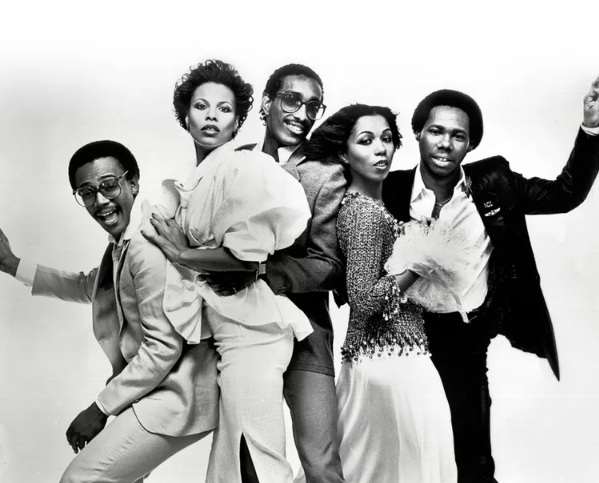
From now on for promo photographs it was Rodgers, Edwards, Thompson, Anderson and Martin. They would be augmented by other band members for TV shows etc and especially live performances. So on the album’s deluxe cover photograph, (taken by Joel Brodsky), we see the core five in a room of a curiously empty but opulent house. The view behind them out into the gardens enhances the feeling of luxury. The track titles are listed below the photograph, which is a clever nod to the past when this was more common on covers, and also gives more impact to the titles.
The back cover is equally as good, with Brodsky’s superb photograph of the five in the corner of a room of likely the same house. Both front and rear images are a perfect fit for the music, capturing the style and elegance of the band.
The first UK edition of this album was called Tres Chic. It added Everybody Dance and Dance, Dance, Dance to the running order (one on the end of each side), which were welcome additions for UK purchasers, although affecting the integrity of the original album. This misstep was compounded by a different, and dreadful, cover image of a woman wrapped around a neon tube against the backdrop of a city at night!
Let’s take a look at the songs . . .
Chic Cheer: The opening audience noise is sampled from Jac Holzman’s Authentic Sound Effects Volume 3 (Elektra , 1964). It makes for a good intro, implying a live performance, with Rodgers’ cheeky guitar lick punctuated by Thompson’s cymbals. It builds nicely from there into the vocals chanting ‘chic, chic, chic’ and then the command of ‘everybody sway’.
From there, it’s a catchy riff from Rodgers with a harmony rhythm guitar part, accompanied by a taut backing track. But it does get rather repetitive, the formula lacking interest or panache. There is no lead vocalist either, and the ensemble vocals merely contribute to the overall problem that there is little that impresses. There are many fans who love this song, but for me it’s average at best.
Edwards remixed the song when it was re-released as a single in 1984. He removed the crowd noises and gave the song more punch and dynamics. The song really does come to life much more, although the drums are far too loud. Nonetheless, this is well worth seeking out.
Le Freak: One of Chic’s best-known songs and the biggest-selling single in Atlantic’s history. The best version is the full-length album take, which is nearly two minutes longer than the single. It’s the album version we will be referencing.
The song’s inception came on New Year’s Eve 1977, when Rodgers and Edwards were refused entrance into Studio 54 despite being invited by that night’s headliner Grace Jones. Back home, they got the funky riff down quickly, ending it with a hook of ‘Fuck off’ – the words from the doorman as he closed the door on them! They changed the hook to ‘Freak out’, and the rest is history.
Also in the lyrics, they reference Stompin’ At The Savoy, which was written by Edgar Sampson back in 1933. Studio 54 also gets a mention, with the invite to ‘Come on down to 54’.
The song opens with a ‘one, two’ before we are thrown straight into the chorus, a guaranteed way to open a song with a bang! In fact we get several choruses. Anderson and Diva Gray harmonise on the verses with an almost nonchalant vibe. Rodgers told Sound On Sound in April 2005 that ‘Alfa’s voice is instantly recognisable to me by the way she sings ‘I’m sure you’ll be amazed’. The word ‘amazed’ is kinda flat and very Alfa Anderson; a cool thing that we used to love. Still, Le Freak is mainly about the music. There’s probably more playing than singing.’
Rodgers added that Thompson’s big bass drum sound was achieved by ‘overloading the live echo chamber, which was the bathroom at the Power Station.’ You can hear the drums at their most intense following each chorus vocal.
For the breakdown with the Chic choir singing ‘I say Freak!’, engineer Bob Clearmountain used studio trickery when recording the handclaps using an echo chamber. By using reverse reverb it meant that the echo came before the clap!
The combination of Rodgers’ euphoric rhythm guitars ( at least two interweaving rhythm parts) and the pulsing bass by Edwards is terrific, and, as usual, there is the cinematic drama of the string arrangement. In spite of that, the arrangement has a sparse feel at times – there is little or no percussion evident and the keyboards are low in the mix.
The best section comes after the ‘Now freak’ exclamation at 2:44. We get an interlude that rises and rises in power until, with nowhere else to go, it drops off with a bass lick from Edwards, connecting it into another verse. It’s just tremendous! The outro is over a minute of choruses with one key attention-grabbing addition – Thompson gets to play an explosive fill, initially at 4:55 and then again at 5:11.
The single got to number one in America. It had three separate runs at the top, broken by Neil Diamond & Barbra Streisand’s You Don’t Bring Me Flowers and the Bee Gees’ Too Much Heaven. On 21 March 2018, the song was selected for preservation in the National Recording Registry by the Library of Congress as being ‘culturally, historically or artistically significant.’
Dimitri From Paris borrows Chic Cheer for a new intro on his mix, which otherwise isn’t significantly better than the original.
(Watch the Le Freak promo video)
Savoir Faire: An instrumental akin to the first album’s Sao Paolo, Rodgers’ jazzy guitar solo is the one he picked out as his best. ‘It’s still my favourite solo,’ he told Gene Santoro for Downbeat (September 1985), ‘because it was the most complete for me. I started the melody with chords, then moved into the jazzy stuff. It was really emotional, and from a compositional point of view, it’s one of the best things I’ve ever played.’
It’s a breezy piece of work that worked well as an opener for side two of the album. For the most part it’s a vehicle for Rodgers who is superb. He stands out in the mix, which heavily features the strings switching between a multi-layered approach to the main melody line and lighter accents when the mix drops down for the more laid back sections. There’s an excellent piano line in the mix, too, which occasionally ‘pops’ out. As great as Rodgers is on this, it would have benefited from the piano line being mixed higher.
Happy Man: Edwards sings lead on this lyrical affirmation of his lifestyle at the time. He is happy ‘spreadin’ all my love around the place’ and happy ‘hanging out all night with the jet set.’
The chorus asserts that ‘the world is my home’, so it seems Edwards was coping well with the touring/ recording lifestyle. However, no insight on domestic circumstances is mentioned! Lyrically this is the positive flip to the later Real People by which time the lifestyle had worn thin.
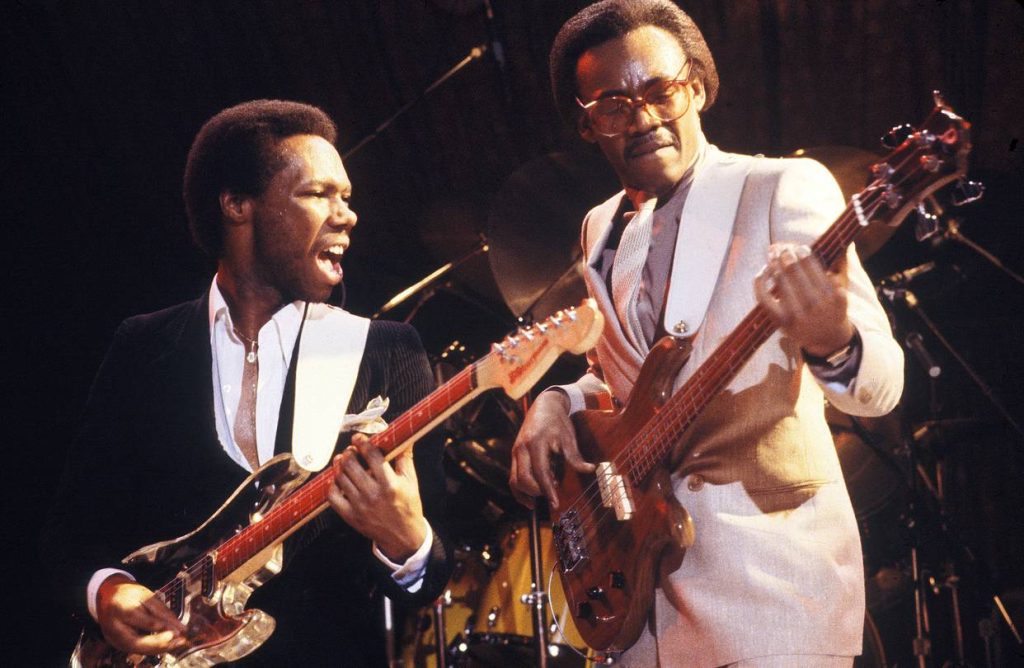
As well as singing Edwards is also magnificent from the off on bass. The intro drops right in on his bubbly bass lick and his main riff has echoes of the one he plays on Everybody Dance. The wandering bass runs he launches into from around the 2:50 mark are a highlight of the extended instrumental outro.
Anderson and Martin provide supporting vocals to lift things up in parts of the chorus, but Edwards handles the verses alone. It’s an exuberant song and the pulsating rhythm track gives it a real driving quality. Rodgers gets an excellent tasteful short solo which is the bridge between the two halves of the track.
All in all It’s not a great song, but it is enjoyable enough for the warm happy performance and the quality musicianship.
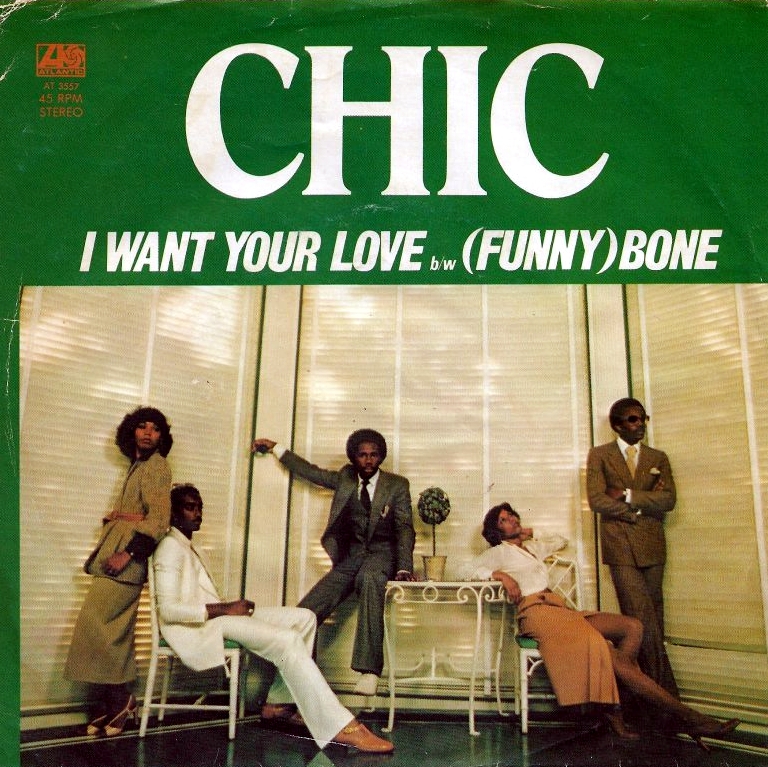
I Want Your Love: Among the several songs which are among the best the Chic Organisation ever recorded, this one is my own personal favourite. Everything that is great about their records could be summed up in this one song, which never seems to lose its freshness and impact.
The album version is the best, being nearly three and a half minutes longer than the single. Therefore, it’s the album version we will be referencing. If the lyrics sound heartfelt, it’s because Rodgers meant every word, as exemplified in 2000’s Very Best Of Chic notes: ‘(It) was about a real-life affair I was involved in, where I was going out with one girl, but I wanted to go out with her best friend.’ The chorus vocals ache with unrequited love, but it’s the verses which have the emotional heart, with Anderson delivering a supreme performance: ‘Just one chance and I will show you love, like no other two steps above’ or – even more heart-tugging – ‘All alone in my bed at night I grab my pillow and squeeze it tight. I think of you and I dream of you, All of the time, what am I gonna do?’
There are so many golden aspects to this song. Aside from the catchy rhythm and guitar melody, there is the ever-present tubular bells and horn section, all perfectly balanced by the strings. The instrumental break at 3:23 is simply overwhelming. Rodgers’ guitars keep the tension going, while the strings soar and swoop from loss to euphoria in a dizzying rush. There’s a lovely part here at 3:57 where it escalates and the brass comes in to play the same melody lines as the strings. It’s just stunning! Rodgers leads the way out from here into the breakdown (4:29), which drops right down to Rodgers’ chucka-chucka rhythm parts along with Edwards and Thompson also keeping the rhythm going.
Sabino’s acoustic piano is there in the mix throughout, but is most evident as they come out of the breakdown. He plays the melody line slowly and very deliberately creating a strong contrast to the rest of the backing track. More from the brass and a heady instrumental whirl lead inevitably into the chorus/outro.
The song reinforced that Chic were so much more than just a ‘disco’ act and was a smash hit single in its edited form in the UK (number four) and in America (number seven).
There is an 8:34 remix by Dimitri From Paris which is somehow even more thrilling than the original. Joni, Debbie and Kim Sledge (as Sister Sledge) recorded the song in 1992 for their And Now Sledge Again album.
(Watch the TopPop performance)
At Last I Am Free: This is an old Rodgers song (predating Chic) which he originally wrote following a Black Panthers demonstration in Central Park, New York. The political lyrics he originally had were reworked into a theme of moving on in love courtesy of Edwards.
There’s a beautiful, airy weightless feel to this sublime ballad. Anchoring the heart of the song is Edwards’ stately bassline, Thompson’s slow pulse drums and a quite lovely piano part from Andy Schwartz. Rodgers plays chiming guitar licks around the trio while the strings add deft, sensitive touches.
Anderson takes the lead on the verses, giving every word emphasis, meaning and depth. I love how she lets her voice hang on the notes at the end of each line; it’s a wonderful performance. The Chic choir softly sing the chorus, adding to the shimmering musical top notes from Rodgers and the strings. The exception to this comes with the chorus at 3:28, which Anderson sings alone. It has the effect of suggesting she has ‘made it’ out of the situation in the lyrics which is holding her back.
From there, it’s repeated choir choruses all the way to the end. Schwartz is quite delightful over this section. His piano part is a stately attractive take on the song’s melody. Everything dies down till there’s only Schwartz left playing and he carries the tune out in fine style. it’s a sublime ending.
It is the best of the Chic ballads and among their best songs. They get so much out of comparatively little in the arrangement and it’s an absolutely masterful piece of work.
Sometimes You Win: This duet (largely speaking) between Anderson and Edwards has a similarly warm, Latin feel to Sao Paolo. They trade vocal lines on the verses, with Anderson handling lead vocals on the choruses alone, along with backing vocals.
A highlight is the brass section, which unexpectedly enter at 3:07. They offer a melodic diversion, but it isn’t a great fit. This section would have been better handled as a guitar or piano break, which would have kept the mood going. The backing track features some Fender Rhodes and Vibes in the mix, but overall, this pleasant song does border on being filler.
(Funny) Bone: An unsatisfactory, closing ‘fun’ track. The brass are back, with Sabino adding punchy clavinet for extra measure. Along with looped party sounds now and then, it’s entirely down to the brass and strings to add colour to what is a rhythmic but dull backing track.
‘Bone’ was a Rodgers/Edwards nickname for Thompson, who has the final words of advice before signing off with a ‘ciao’! An outtake version was included in the Savoir Faire box set. This is a run-through of the backing track by Rodgers, Edwards, Sabino and Thompson. It’s inessential listening and merely highlights that more was needed to make this track work.
C’est Chic is one of two at the summit as their best work. The band were on such a roll that their next band record, Risque, would join it at the top.
(This piece is adapted from the section in my book The Chic Organisation – every album, every song). With grateful thanks to the contributions here from Sammy Figueroa, Jean Fineberg and Ellen Seeling.