‘You’re searching for your mind don’t know where to start,
Can’t find the key to fit the lock on your heart’
Ozzy Osbourne: vocals Tony Iommi: guitars, flute, piano, synthesiser Geezer Butler: bass Bill Ward: drums, percussion
The album title comes from Geezer. The lyrics, largely written by him, are observations on reality and he saw the final product, recorded on a master tape, as ‘a master of reality’. He told Metal Hammer in May 2021 that: ‘Sabbath was all about the dark reality of life. At the time of Master Of Reality, Vietnam was raging, the Cold War was at its coldest, the Troubles in Northern Ireland were close to home. A few others were singing about the underside of life, but we had the heaviness to hammer the subjects home.’
A common complaint is that the album is too short, which it is by about 5 or 6 minutes. Tony’s admission to Uncut (July 2014) that, ‘We’d been touring so much on the Paranoid album, by the time we’d got to the studio we’d not had much time to come up with stuff’, tells exactly how it was. By the time they got down to recording they were still short of songs and this is largely how two short guitar pieces came to be added. Both were composed by Tony in the studio to flesh things out and add to the light and shade that was becoming a trademark. As well as the guitar pieces, Solitude was something of a resurrected song, leaving only five completely new band tracks.
The one known unused out-take, Weevil Woman, could have been made to fit, although it would have been extended longer than than the three minutes it lasts. If it had been included then Orchid would likely have had to go, and the balance of the album would have been affected.
In all they spent a luxurious (by their previous standards) ten days in total recording the album. The first session was on 1 January 1971 at Island, with further sessions put in whenever possible until the final studio dates from 25 to 27 May.
While Paranoid had its dark moments, the band take it several notches further this time. Tony recalled in his autobiography Iron Man that, ‘We tuned down to get more power and a fatter sound. Of course, Ozzy started singing higher. He’d go, ‘Oh, I can reach that note now.’ However, when we got on-stage he couldn’t do it.’ This explains why several classic Sabbath songs never, or rarely, made the setlist.
The decision to drop the tuning to C# on Children Of The Grave, Lord Of This World and Into The Void gave those songs a heaviness the like of which had not been heard before, along with a pervasive gloomy atmosphere. The other big tracks, After Forever and Solitude, are in D.
There was social commentary on the Paranoid album, but an air of distance in the communication. Master Of Reality feels more personal, as though Ozzy is talking directly to the listener.
Tony’s immense riffs were already a huge part of Sabbath’s sound, but on this album his guitar is dominant like never before. As well as unintentionally inventing grunge, the dropped tuning meant his strings were less tightly wound, so Tony could play in more comfort (because of his hand injury a few years previously). The thick doomy sound also pervades the tracks which aren’t in C#. Tony’s solo acoustic piece, Orchid has an unsettling quality, while Solitude‘s morose lyrics are barely lifted by his lilting guitar.
It’s not just the dropped tuning that Tony, and also Geezer, adopted that gives the album its startling sound, it’s Bill’s drums too. They have far more power in the Island Studios set-up than he got for Paranoid at Regent Sounds. There his drums had all been close miked, but this time use was made of ambient miking and boom mikes giving the drums more presence.
It’s hard to think of anything else from that time which matches this album in terms of in-your-face dynamics. Ozzy is on imperious form, he seems practically in front of you – almost a live performance. Behind him the band rock hard and swing like their lives depend on it. The energy levels just crackle.
There was no single from the album this time. The subject matter in any of the contenders would have been problematic, but in truth nothing has the catchiness of Paranoid. It also would have made a short album look even less value with a single pulled off it!
One tune which was omitted was a Disney classic. The band spent an hour and a half with engineer Tom Allom marching up and down stairs singing Hi Ho from Snow White. It was supposed to end with a door shutting followed by the intro riff of Into The Void. The idea never worked out and was abandoned.
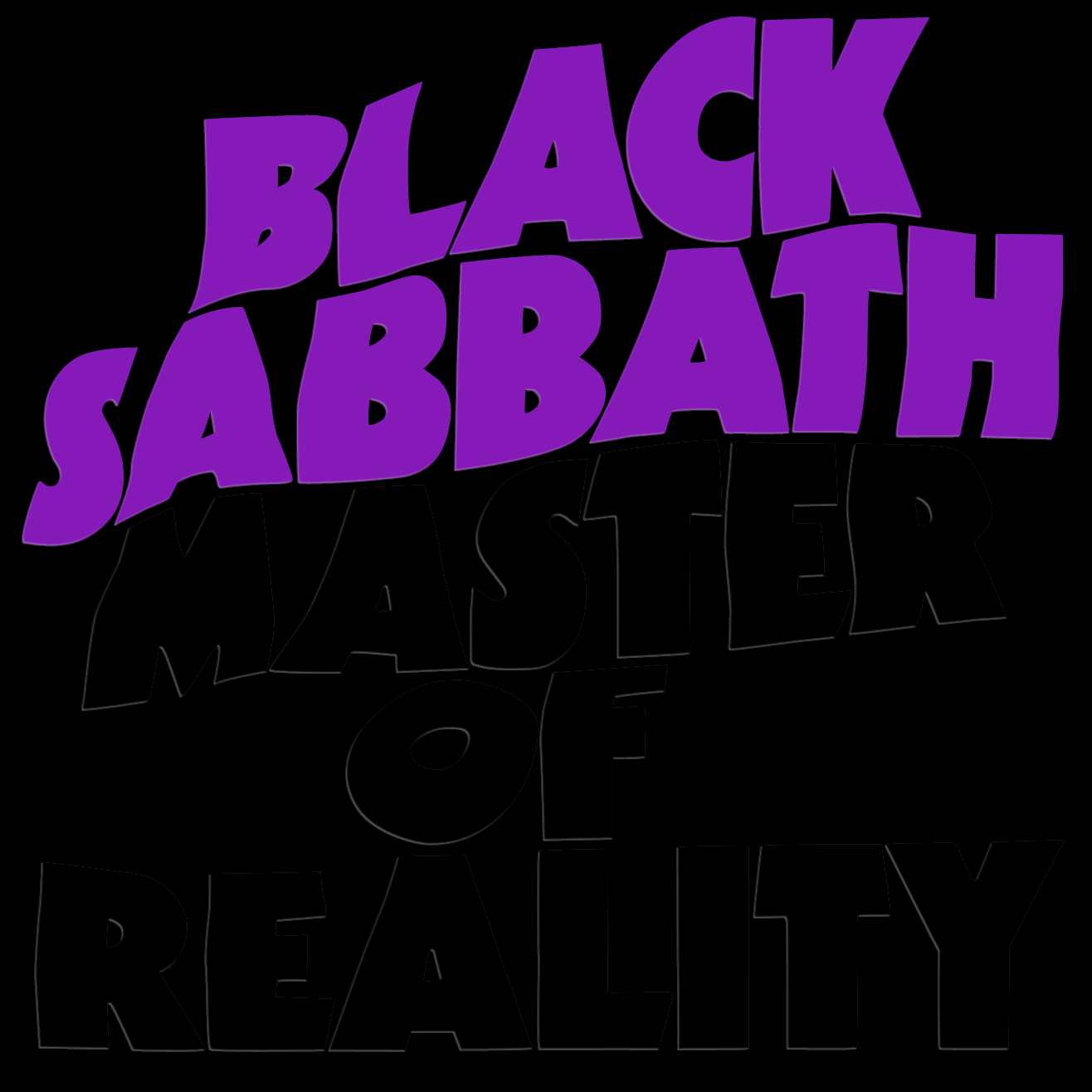
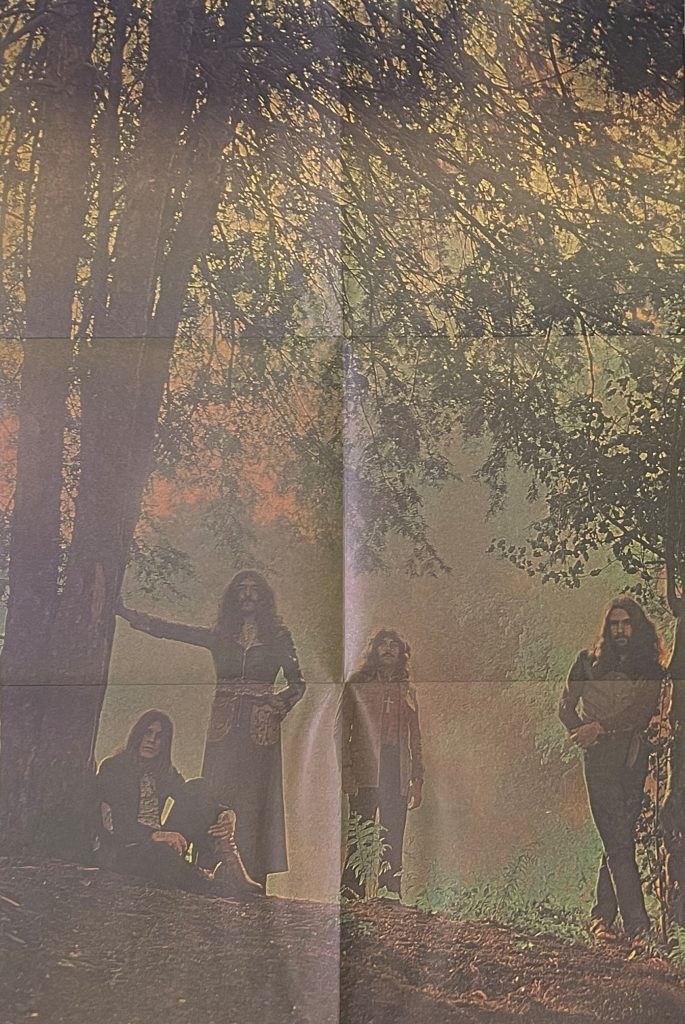
Keith McMillan returned to do the cover. He came up with a stark simple design of bold lettering on a black background. The production of the sleeve was handled by The Bloomsbury Group, and to make it stand out they embossed the lettering for the UK release. It also had a flap style closure to the sleeve. On the back were Geezer’s lyrics, featured for their thought provoking content and also to help them (hopefully) from being misconstrued. Inside, along with the record, was a poster of a group photograph taken by McMillan in Black Park. The soft muted tones of the image capture the mood of the record perfectly.
Let’s delve into the tracks. Sweet Leaf was one of the last songs put together for the record, with work on it only starting on 25 May, two days before sessions ended. Geezer recalled the lyrical inspiration in a 2001 interview with Guitar World: ‘I’d just come back from Dublin, and they’d had these cigarettes called Sweet Afton, which you could only get in Ireland. I took out this cigarette packet, and, as you opened it, it’s got on the lid: ‘It’s the sweetest leaf that gives you the taste’. I was like: ‘Ah, Sweet Leaf!’
It opens with Tony’s cough, recorded after he took a drag on a reefer handed to him by Ozzy, before a take of Orchid. It’s crazy but it’s an appropriate attention grabbing intro. As soon as the band come in there’s a real sense of them being, well, unleashed. The primal power just hits you from the off.
The interplay between Ozzy’s vocal and the riff is clever, the vocal pauses allowing the riff to ‘pop up’ at you. The audible string squeaks as Tony frets the notes also work, even though there would have been no intention for them to be part of the recording. The fuzzy molten tones that he gets are complemented by Geezer’s bubbling bass and a steady rhythm from Bill, to which he adds some great fills between verses.
The middle eight at 2:27 marks a change of tempo, as the band switch up through the gears for a breathless instrumental break. Bill’s gong shimmers as they lock into a tight groove. Tony’s rhythm guitar drops out of the mix just as his trilling lead guitar comes in for his solo spot. It’s a brief solo, with Geezer and Bill keeping up the relentless rhythms until they pull off one of their wonderful tempo changes (as in Iron Man on Paranoid). A split second pause and then an almighty crash back into the main riff. It always makes me smile and and shout ‘yes’ – usually in my head but sometimes still out loud.
Ozzy comes back for a final verse, imploring the listener to, ‘come on now, try it out’. After that they swing on that big riff all the way to the outro as Ozzy improvises a vocal line. It’s one of their biggest opening tracks and a Sabbath classic.
Tony’s solo credit for writing After Forever has to be an error, given that Geezer wrote the lyrics, which Tony himself acknowledges in Iron Man. The track was one of those they worked on at the first session on 1 January.
It opens with what sounds like cymbals recorded backwards and put through a flanger. Tony’s chiming guitar comes in next with bubbling bass from Geezer. Along with Bill’s drum track there is also some tambourine added for effect.
The verses feature a chugging riff as Ozzy sings the often misunderstood lyrics. The line, ‘Would you like to see the Pope on the end of a rope’ was controversial, but the lyrics question that perspective rather than support it.
The middle eight is the variation. Tony comes in with a slow riff with Geezer and Bill in unison as Ozzy sings, ‘could it be you’re afraid of what your friends might say if they knew you believe in God above’. You expect the solo to come next, but instead they switch back to the intro riff (at 2:36).
The surprise is that they have another variation to pull out. In comes a new riff at 3:26 which is a more agile and spritely version of the one in the middle eight. Now we get the long awaited guitar solo. It comes in at 3:37 and you can clearly hear the sound change as Tony’s rhythm part is faded down to give his overdubbed lead guitar space to shine. As his solo picks up it is panned increasingly faster from speaker to speaker until the intro riff comes back in again.
The track could have been faded out after the 4:10 mark and it would have worked well, but there is still over a minute to go. Given the album’s abbreviated running time it feels like it was extended to make up the minutes. Consequently we get another verse, which feels like one too many. The outro is better as they lock back into the intro riff with the effects stepped up, climaxing with a repeat of the intro backwards cymbal sounds.
The song has been somewhat overlooked, due to the top- drawer quality of the several bigger hitters on the album, and also never being a live set staple (at least in the 70s). There is a rushed feel to it and it would have benefited from a stronger middle eight, but it’s an enjoyable track.
Tony plays Embryo on a detuned electric. He cleverly plays the melody on the top strings while leaving the bottom two to reverberate. The track’s bucolic feel has uneasy, even sinister, overtones that hint at the menace to come. There’s not much to it in its own right, it’s a mere 38 seconds long, but it perfectly sets up, and puts you in the mood for what follows. . .
Children Of The Grave lyrically is a warning, and something of a lyrical prequel to Electric Funeral off Paranoid. Geezer’s lyrics ask, ‘must the world live in the shadow of atomic fear, will they win the fight for peace or will they disappear.’
It’s another of the last songs to be worked on for the album, first run through on 25 May. It is an outstanding Sabbath track and a contender for being the best song they ever recorded.
The unease from Embryo is maintained in the intro, a low rumbling rhythm in which you can hear the staccato picking of Tony’s plectrum. The riff that comes in is a killer, alternating between a smooth chord progression and a staccato riff, underpinned by Geezer’s bass doubling it.
Bill’s clattering overdubbed timbales work is the memorable extra ingredient. As well as that he uses double bass drums to power the galloping rhythm track along. Ozzy handles the vocals with his usual aplomb, while Tony adds a squeal of guitar (overdubbed I think) at the end of each of Ozzy’s lines to add emphasis.
The middle eight comes at 2:08. A quick linking riff played in unison by Tony, Geezer and Bill makes way for a monumental riff that defines this track as much as the more familiar main riff on the intro and verses. It’s an evil beast of a riff with Bill playing an almost military beat on his toms behind the huge sweeping riff. In the background there is an organ part doubling Tony’s riff, played also by him or engineer Tom Allom.
The switch out of the middle eight leads back into the main riff and a final verse, capped off with Tony’s solo at 3:43. He double tracks a second lead part onto it, the two parts duelling from different speakers. The thicker melodic sound he gets from this works well over the riff.
The outro comes at 4:17 with Tony’s repeated squealing riff (doubled by Geezer) that is not dissimilar to the punctuations he used on the verses. Rumbling timpani from Bill fades up louder, getting more ominous, but there is no crashing final chord as you might expect. Instead a sinister noise comes in, which sounds like Tony’s guitar with an effect used on it. It pans from speaker to speaker as Ozzy’s whispered voice spectrally intones ‘Children Of The Grave‘. It’s a truly disturbing ending, which, it has since transpired, could have been even more unsettling if they hadn’t faded it out. The full length version is on the instrumental out-take.
Orchid is not the side two opener you might expect. Only Tony features on it and he uses a dropped tuning to get the quietly still quality. He plays a steel strung acoustic guitar in a fluid Spanish style, the muted tones heightened by reverberating bottom strings that come and go. It’s another admirable piece of work that bears repeated listening as well as doing the job of softening us up before Lord Of This World.
Lord Of This World lyrically is a simple but thought provoking tale. Geezer has said that it is the devil speaking in the first person but that is not overtly clear in the lyrics. He observes that mankind has turned away from their creator, ‘You made me master of the world where you exist’ and questions who you will turn to ‘when it’s your turn to die’.
The intro is a twisting subtle riff with Tony and Geezer in unison, while Bill’s drum fills add contrast. The main riff comes 28 seconds in, and is another one of Tony’s best – melodic and catchy but still heavy due to the dropped tuning. At 30 seconds you can just about hear the piano part that wasn’t used on the final take, but survives as a couple of clear notes. It may be a bleed through on the rhythm guitar track. The verses have an edginess with Ozzy’s precise emphasised diction, singing along with the guitar riff. It’s his performance that is the stand-out.
The usual switch comes at 2:03 without any real tempo change this time. Tony plays a variant on the main riff and Bill taps out the same riff (a little basically) on his percussion. The guitar solo comes in at 2:17 with Geezer adding a brilliant complementary bass part. At 2:35 Tony adds a second lead part to harmonise with his solo. Ozzy sings a middle eight section at 2:59 which sees the only mention of the title.
There’s time for one more verse which sets the seal on things before the big finish. First up is a repeat of the instrumental section from 2:03, complete with Bill’s tapped percussion. The section that follows this with the two harmony lead guitar parts also repeats as before. The surprise on the outro is a new riff, coming in at 4:58. It might have been something they could have built a whole new song around, but as a final surge of energy it does the job just fine. This popular song didn’t get to be a live staple in the 70s but in the down-tuned reunion era it at last found a place in the set and always went down well.
Solitude‘s lyrics were originally written by Geezer and Ozzy way back during the Earth days. The surviving lyric sheet (SAG-2016) has the song titled as Changing Phases. The new single word title, Solitude, is a more effective and empathic summary of the effects of depression on the mind.
It takes its place on the album in the same way that Planet Caravan did on Paranoid – a chance for the band to show another side to their music. The despair and futility in the lyrics is accompanied paradoxically by a beautiful swing feel and lilting quality to the music, with Tony’s guitar and Geezer’s bass holding down different but complementary melody lines. A delay is used on Ozzy’s voice to enhance the distant, wistful feel of the song.
Great care was taken with the instrumental details which add so much to the effect. Tony’s flute part is simple but effective and the tinkling sleigh bells, courtesy of Bill, are mesmerising once your ears lock into them. It’s his only contribution and he plays them on most of the song.
The second verse features a snatch of piano which sounds like it had been treated with reverse reverb, giving the effect of the piano whooshing in. The piano is kept in the mix for the remainder of the song making the sound thicker.
Tony’s solo is at 2:32 and he opts to play a slight variation on the melody line, which maintains the feel of the song. At the end of the third verse (at 3:53) Tony’s flute features more prominently on what is an extended fade-out, finishing off with just those tinkling sleigh bells, which leave your ears straining to hear them.
It’s a wonderful touching song, which deserves to be better known. Sabbath never played it live but It has been covered by Opeth in concert, who delivered a great version of it
Into The Void is about what is left of mankind escaping an earth ruined by nuclear war, something of a sequel to Electric Funeral. Tony recalled, in Iron Man, that it was a problematic song to get down: ‘We tried recording (it) in a couple of different studios because Bill couldn’t get it right. Whenever that happened, he would start believing that he wasn’t capable of playing the song. He’d say, To hell with it – I’m not doing this!’
The intro is a scene setting device, establishing the mood and feel of the track. Tony’s glissando down the frets is followed with a slow insistent riff, joined by Geezer and Bill. Geezer’s top notes bubble out of the stew, which continues, with a brief variation, until 1:13 when Tony switches things around with THAT riff, the one that you wait for. The stuttering attack of it is underpinned by Geezer and Bill anchoring the song superbly; Geezer’s bass is the pulsing heart of things here. Ozzy finally steps up at 1:39. The lyrics are a tough ask – a stream of consciousness with scarcely chance to pause for breath – but he pulls it off.
At 3:03 they switch and up the tempo with the interlude riff, where Ozzy sings the ‘Freedom fighters set out to the sun’ verse. Listen out for Bill as he contributes a blistering drum part. It all stops and changes in a split second as the main riff comes back in at 3:32 for a repeat of the opening part of the song but with different verse lyrics. Tony takes his first solo at 4:46, surprisingly late, and adds a barely audible second solo part underneath it. It’s not one of his best solos, but it’s good enough.
There’s a brilliant call and response at 5:15 between the rhythm section and a shivery fuzz toned guitar lick from Tony. Listen out for an over-dubbed lead guitar part that sounds like it was recorded much later, the squeals cutting right through. Tony then slides down into some bluesy notes before locking back in with Geezer and Bill for the outro riff, which ends on an echo of Tony’s guitar.
Into The Void is a classic Sabbath song, with one of Tony’s top riffs. Like Lord Of This World it surprisingly never really got into the setlists back in the 70s, but secured its place in the live set in the reunion era, where that riff was always greeted with frenzied delight.
Early Sabbath albums in America had ‘extra’ tracks created so they would meet the quota required for each record. To achieve this they renamed intros or outros. Four were created for Master Of Reality. The Elegy is the intro to After Forever up until the heavy riff comes in at 34 seconds. The Haunting is the spooky outro to Children Of The Grave. Step Up is the 27 second intro riff to Lord Of This World. This is repeated later in the song. Finally, Death Mask is the first part of Into The Void up until 1:14 when Tony cracks out the main riff.
A two disc deluxe edition of the album was released in 2009, the second disc featuring alternative takes and, best of all, a previously unreleased song! There are four tracks which stand out for me . . .
Weevil Woman 71 is a previously unknown and unreleased song, recorded at the first album session on 1 January 1971 but subsequently abandoned. The title obviously refers back to Evil Woman, but otherwise has nothing in common. It’s typical of the heavier tracks on the album, driving along on a choppy crunching guitar riff. Ozzy’s guide vocal line would have changed in time, and the arrangement refined and honed if they had continued with the song, but it was not to be. The band obviously felt they had better material coming through and it wasn’t worth persevering with, but, given the album’s brevity, that seems a mistake.
Sweet Leaf (alternative lyrics) was recorded on 25 May this features Ozzy’s guide vocal and lyrics. It’s main interest I think is because Ozzy clearly has future plans on his mind as he sings, ‘I want you baby to be my wife, to love and cherish for the rest of my life, you want me too to be your man’. Thelma was very much on his mind, and no wonder as they were married the following month.
Children Of The Grave (instrumental) has Bill’s percussion overdubs present and correct; all that’s really missing is Ozzy. The crucial point is that it’s 46 seconds longer than the album version, which in essence means more of The Haunting outro. Added in the background is an organ playing a familiar fairground/ circus tune – Sobre Las Olas (Over The Waves) by Juventino Rosas. The incongruity works incredibly well and they should have left it in for the final master take (although a tiny tiny fragment can be heard). I think they should have kept this expanded ending for the album version.
Lord of This World (alternative take). It was set to be ‘the one’ for the album but was replaced. It’s worthy of note because it features overdubbed slide guitar parts by Tony, which the album version does not have. There is also a piano adding support to the riff all the way through, which may well be Tony too.
The piano and slide parts were rightly deemed superfluous to requirements – they dilute the impact of the song. That being said, the extra parts make it one of the most interesting of the outtakes to have emerged.
(This piece is edited from the section in my book Black Sabbath In The 70s)