‘She asked me why the singer’s name was Alice.
I said, ‘Listen baby. You really wouldn’t understand.’‘
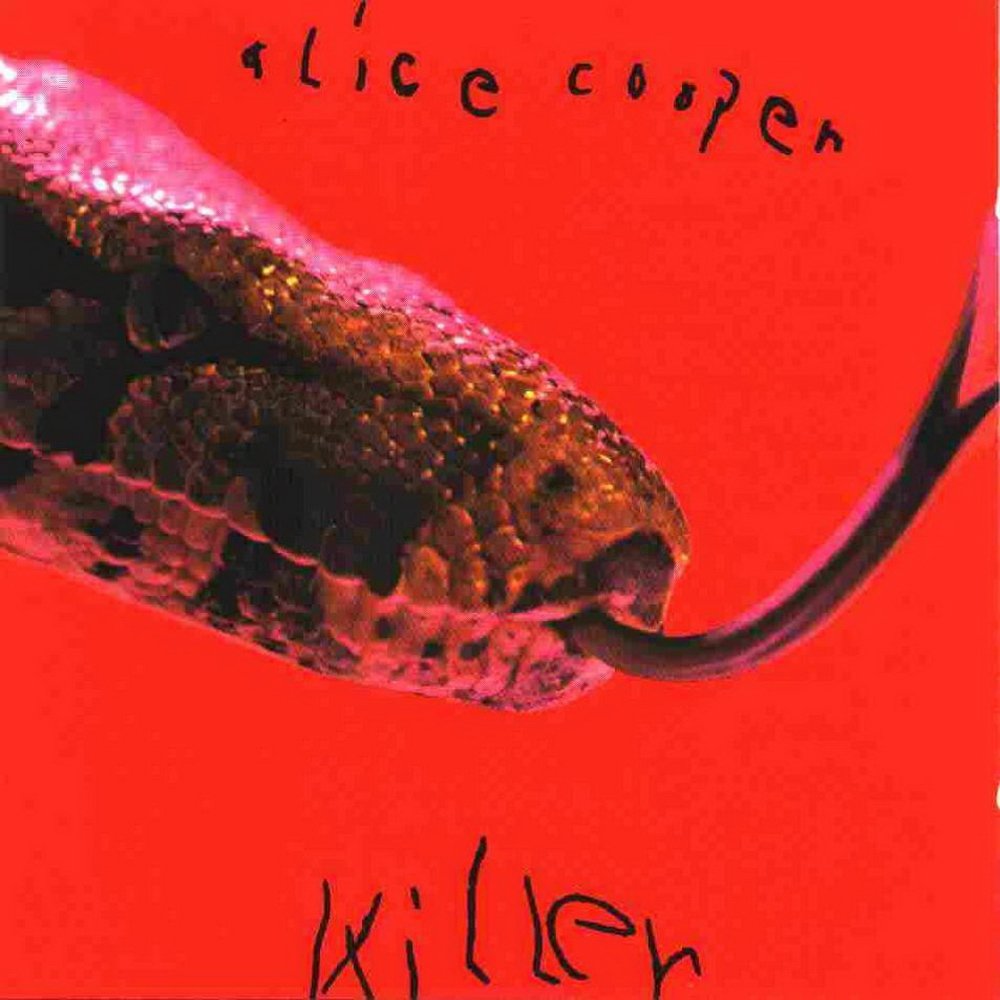
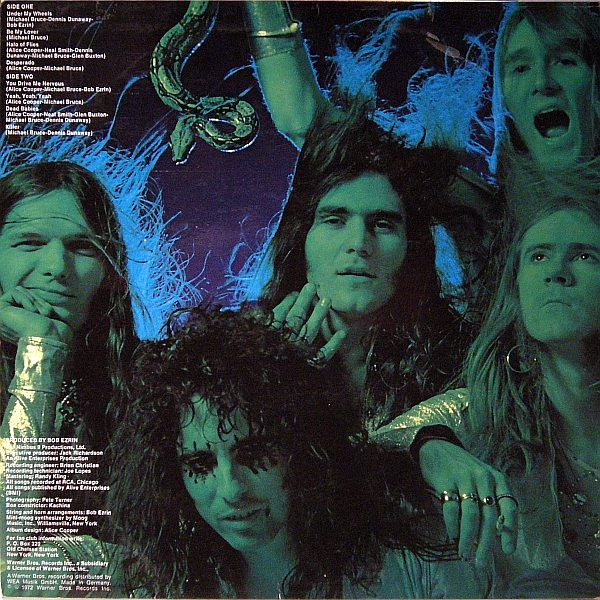
Alice Cooper: vocals, harmonica Michael Bruce: guitar, keyboards Glen Buxton: guitar Dennis Dunaway: bass Neal Smith: drums, percussion Bob Ezrin: production, Moog synthesiser Rick Derringer: lead guitar on Under My Wheels, rhythm guitar on Yeah, Yeah, Yeah.
Killer is one of a golden run of albums by the Alice Cooper Group. It came out in late 1971 and built on the quality of their previous album Love It To Death (also 1971) by taking everything up several notches. The songs are as strong, if not stronger, and the sound is more dynamic and cinematic. Everything seems more dramatic and the band are audibly oozing in confidence and panache. Not a minute of the album is wasted and there’s no filler – this is an intense album which covers all sorts of moods and emotions.
It really deserved to do better in the charts than it did, although it reached a credible 21 in the USA and 27 in Britain. Part of the reason for it not charting higher was that the the two singles (Under My Wheels and Be My Lover) didn’t do well in either country. In fact they didn’t chart at all in Britain. If either had gone top ten it would have doubtless give then album more traction too. Despite that Killer is often cited by fans as the best album by the original band. One who concurs is Dennis, who says, ‘We were all playing at our best and we were all confident. The band was a complete unit, and it was still the band making all of the decisions.’ Let’s take a look at the eight songs. . .
Opener Under My Wheels is one of the greatest shots of adrenalin in the group’s work. It comes crashing in, a big statement of intent that the group mean business. There is a confident swagger in the music, and the doubled rhythm guitar attack of Glen and Michael give the riffs real crunch. Great accents and fills from Neal too.
When it came to the scorching guitar solo Ezrin used the visiting Rick Derringer’s take instead of Glen’s. Dennis was bemused: ‘I loved what Glen played on Under My Wheels.’ For some reason he buried Derringer in the mix behind a wall of unnecessary brass, instead of giving him the stage to let rip, as you can hear he was doing.
Be My Lover follows. It’s a catchy, breezy song which drives along on a cool riff not dissimilar to The Velvet Underground’s Sweet Jane. Neal observes that, ‘A lot of the songs that became our most popular were written or started by Michael. Those melodies he has are very catchy. Dennis adds: ‘We put some pretty dramatic changes in it. It came in like – ‘that’s the song, now all we have to do is write our parts.’
Two women feature in the song’s lyrics. Kit Pandel was band publicist Ashley Pandel’s sister and clearly made an impression – ‘She struts into the room, well I don’t know her, but with a magnifying glance I just sort of look her over.’ The second was an elderly lady, sat on a plane next to Michael, who really didn’t understand how the singer (a man) was called Alice! Michael elaborates: ‘The first verse – she definitely caught my eye, she was a very beautiful woman. The second verse actually happened on the airplane. There was this elderly lady and when I said you really wouldn’t understand, I thought it would go in one ear and out of the other. The first verse was back in the day in Detroit and on our way to making it big kind of mind-set. Verse two – now we’re travelling around on the jet plane.’
Alice’s conspiratorial vocals, with plenty of reverb, keep you hooked with the ‘story’. The outro is a great burlesque section, where Alice practically invites us upstairs, making for a suitably sassy ending, complete with Neal’s twirled drumsticks dropping! The song was released as a single (backed with You Drive Me Nervous) and got to number 49 in America.
The third track, Halo Of Flies, is the best on the album. The band are at the top of their game for this ambitious spellbinding track; it’s a thrilling journey through their influences, with the twists and turns of a Hollywood blockbuster soundtrack. It consists of several sections of what were originally different pieces bolted together. It works because of the skilful linking, and it plays out exactly like a film score mirroring the changing scenes. Let’s take a close look at what I think is the band’s overall crowning glory.
The first part opens with a pulsing guitar riff, doubled by Glen and Michael, sounding like a slowed down insistent siren. The only other sound is Neal’s creative cymbal splashes, adding to the rising tension. At 0:25 the pressure drops and Dennis enters on bass for a short but melodic interlude before things step back up for a heavier sequence at 0:34. Ezrin’s moog blips are right out front here but behind them there is a clever riff played in unison by the rest of the band, with lovely drum fills by Neal at the end of each phrase.
Change of pace again as a watery sounding keyboard comes in, and the music gallops (1:14) like a runaway horse. The track is often singled our for Neal’s drum parts. He feels that: ‘The overall barometer for a drummer to play what I did in Alice Cooper songs is Halo Of Flies. There’s a swing beat to it like the classic big swing bands of the 40s. It’s got that human feeling in there and that’s the swing.’
At 1:33 the dense atmosphere clears as Alice enters. His phrasing is a constant delight, with the nod to My Favourite Things on the line ‘Daggers and contacts, and bright shiny limo’s’ being one to savour. He runs through a gamut of spy movie tropes until the drama comes to a head at 3:28. If you had to distil the best elements of his voice down to a single word, then you can’t top the goose-bumping power he gets behind the word ‘flies’ in ‘And I will smash, Halo of Fliiieeesss’.
As he stretches out the word the band come back in hard and aggressive for a heavy riff sequence as Alice takes us overseas (as the James Bond films always do). With one final verse of spy references including the immortal, ‘I put a time-bomb in your submarine’, he realises that, ‘You never will understand.’ With a tone of resignation he leaves.
Now, at 4:33, we are off to the far east, for a sequence that sounds for all the world like something Wilson, Keppel & Betty would have done the sand dance to! At 5:10 Dennis’s bass ripples up over some string effects from the Moog. The Moog dominates the melody until it drops down and away leaving an insistent throbbing bass line, soon joined by percussion.
Way ahead of trends, what we get here now is a drum and bass solo. Neal: ‘We took the drums into the ladies’ rest room of the RCA Studios in Chicago. Dennis gets that swing in the bass part he is playing under the drums and keeps it going. That gives me the open air to play the solo.’ Dennis: ‘There is an easier way to play that bass part but I refuse to do it.
We decided drum solos had become so cliché so I said we’re not gonna do a drum solo we’re gonna do a duo – a bass/ drums duo.’ It doesn’t outstay its welcome and it works perfectly in the context of the track.
At 6:30 Michael, Glen and Bob Ezrin come back in for the final rush to the end. A full-on assault attack based round the main theme and increasing in tempo. Somehow Michael or Glen finds space to get a guitar break in at 7:17 without interrupting the flow which builds and builds to the final frantic riffs and the swooping climactic keyboard/ Moog splashes followed by a huge musical full-stop from the band. The end of a breath-taking inventive track that proves beyond doubt that this band could seriously play.
The track was released as a single in Holland and Belgium in 1973, backed with Under My Wheels. It got to number 5 in the Dutch charts and 15 in Belgium.
Desperado, a cowboy death ballad that doesn’t drop the album’s intensity, concludes side one. The song started off as Dennis’s work. ‘I wrote a song called Desert Night Storm and I had the Spanish kind of feel, and then Michael changed some of the chords and Alice changed a lot of the lyrics. All of a sudden I didn’t get any writer’s credit. But I did get my name on some songs I had less to do with, so that was ok.’
Alice usually says the song is dedicated to Jim Morrison and that is conceivable given that the Doors’ singer was a personal friend and had died not long before they started recording. And Alice does adopt a Morrisonesque voice on the verses. However, he also has said that it was inspired by Robert Vaughn’s character Lee in The Magnificent Seven, and this is very credible given that the lyrics are a fair description of him.
The verses are suitably downbeat and sombre in tone, which makes for a contrast to the choruses which put the energy into the song. The acoustic guitar melody is one of the band’s most attractive, while Ezrin adds moog synthesiser strings to the mix that pick up on the reflective feel and contribute to the Western movie overtones.
The scorching stunning bluster and edginess of You Drive Me Nervous opens side two. Dennis: ‘It had been kicking around for years. We would bring the song up and there was always something wrong with it. When we were in the studio for Killer and it came back off the shelf again. We loved the song but it wasn’t moving like it should. Ezrin said, ‘Neal play a straight beat, forget all that stuff, and that did it. All of a sudden it took off.” Neal adds: ‘It’s flams all through the song, which is a basic rudiment of percussion.’
The band don’t get anywhere near enough credit for their ability to rock out and this is one of their best in that vein. A breathless ride powered along on Neal’s drums and a rhythm guitar part to die for from Michael. Those ‘nervous’ guitar fills from Glen add the icing on the cake. Michael observes: ‘That thing Glen did in the middle, you know, that wild whammy bar thing? Glen was ahead of his time with that. I was listening back to it and all the little riffs I added in there add a lot to the flavour.’ Alice is on superb form, especially when he sings: ‘You run around with all that hair, they just don’t like those rags you wear.’ The emphasis he puts on ‘hair’ and ‘wear’, stretching the words out, shows a vocalist simply oozing in confidence.
There is a sly nod in the song to Eddie Cochran – another disaffected youth. Alice sings ‘Your mom and papa come up and said’, to which the band’s sound man Artie King responds: ‘Honey, where did we fail?’, channelling the dialogue with Eddie’s boss in Summertime Blues. Everyone grinds out the final riffs which die away as Glen’s guitar wails off into the distance. Fabulous!
The muscular twisting Yeah Yeah Yeah is sequenced to provide warmth and even light relief between the frantic assault of You Drive Me Nervous and the sombre Dead Babies. It’s a deceptively low key track, missing much of the drama and dynamics of the rest of the album, but there’s a lot to enjoy here.
The change in tempo at 1:44 with a shrieking lead riff from Michael also features Alice on harmonica. You don’t hear him play it that often, and here he even gets a solo. On top of that he also gets to deliver the classic pay-off line of, ‘This is Alice speaking – suffer!’ On a trivia note Rick Derringer appears again, this time playing rhythm guitar, while Michael is on lead.
Dead Babies is an often misconstrued song. It is actually about the consequences of child neglect but that message was easy to forget or miss altogether given that live versions featured Alice taking an axe to baby dolls!
Dennis reveals: ‘It was put together from two songs, one had a great chorus and a lousy verse and the other song had the opposite. So I said, ‘Let’s take the good verse out of that song and take the good chorus out of that song and put them together.’ I wrote a new bass line to tie the two together.’
Dennis opens the song with a slow heavily picked bass riff telling you instantly this is going to be a gloomy hard ride. It is the perfect intro for one of the grimmest songs in their catalogue. Michael and Glen join in with guitar arpeggios before Alice sets the scene with the ‘killer’ opening line, ‘Little Betty ate a pound of aspirin, she got them from the shelf upon the wall.’
Betty’s last call for mommy at 0.59 is almost unbearable but it gives way to a chorus that is almost sugar-coated euphoric if you don’t listen to the words! The family background is explored in the verses, but the song becomes all about that chorus that gets right inside your head.
The long outro, beginning at 4.33, is an epic last minute or so with everything cranked up, the emotion pouring out as we hit more choruses. The brilliance here is the addition of a swelling brass arrangement (on the Moog). It all breaks down into an angry court room as the judge calls for order. A killer needs to be sentenced. . .
And here we are for the finale – Killer. An insistent bass run cuts through the crowd noise with oncoming shards of razor sharp guitars, flashing to the killer in the condemned cell reflecting in a tuneful but resigned manner on what got him to this point, ‘What did I do to deserve such a fate.’ The ‘wailing’ pained guitar sounds section that comes in at 3:35 could easily be used for headache medication commercials! Nobody does pained guitar better than Glen!
Everything leads up to the grimly compelling outro to the song and culmination of the album. Neal’s martial drum roll kicks it off with Dennis’s counter bass melody and some sad organ phrases from Ezrin. Listen carefully too for the distant choir vocals. The priest (who sounds like Bob Ezrin) issues a blessing in Latin, as the killer is led to the scaffold. A few more power chords on the guitar, a pregnant pause and then the awful rattling sound of the trapdoor springing. The Moog synthesiser ending that follows is an ear splitting white noise/ swarm of bees crescendo, a literal rush of blood, silenced sharply to nothing.
The three bonus alternative studio cuts on the Killer expanded and remastered set are for connoisseurs, with the looser vibe version of You Drive Me Nervous the most interesting. The alternate Under My Wheels and Dead Babies have their points of interest too, such as Wheels not having the brass overdub.
The real deal on the deluxe tracks though is the nearly complete soundboard recording from the Mar Y Sol Festival (in Puerto Rico) from April 2 1972. Missing is School’s Out (grrr) but you can get that from the Old School box set. It’s a barnstorming performance from the band. Stripped of the studio frills they seriously kick ass.
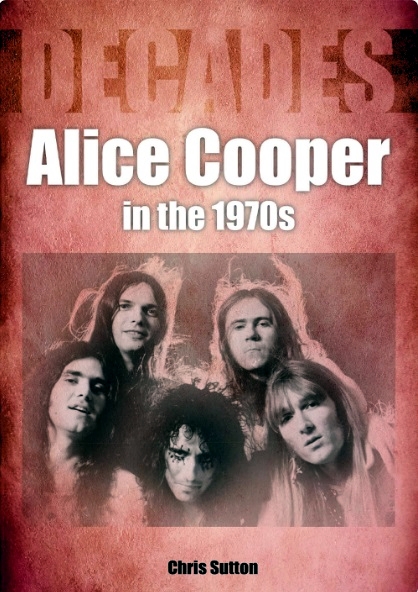
This piece is edited from my book Alice Cooper In The 1970s. I remain very grateful to Michael, Dennis and Neal for their comments to me.