‘How I wished my folks were gracious hosts and not dismayed. But wit and wisdom take a backseat girl when you’re that afraid’
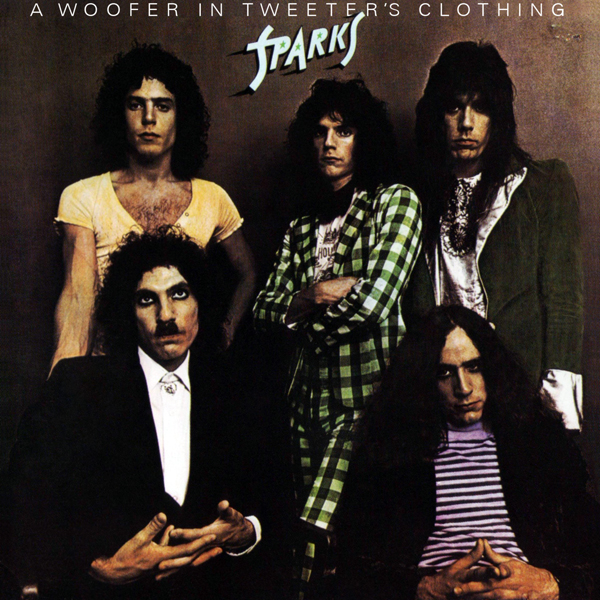
Russell Mael: vocals Ron Mael: keyboards Earle Mankey: guitars, vocals James Mankey: bass, guitar Harley Feinstein: drums, percussion Kip Tulin: accordion on Beaver O’ Lindy
Jules Vogel: string arrangements on Here Comes Bob produced by(Thaddeus) James Lowe
Woofer, the sophomore Sparks album, came out on Bearsville in October 1972. Their debut had bombed but Bearsville felt a second album could be ‘the one’ to give Sparks a lift. Todd Rundgren, who produced the first album, was otherwise engaged so Albert Grossman asked engineer James Lowe (also of the Electric Prunes) to produce it. Lowe agreed and knew exactly what he wanted to do: ‘I thought the first album sounded a little separated, a little bit juvenile. What I was looking for was to try and psychedelicize them a little bit, make them seem like a band.’
Before work started on the album, Lowe recalls that, ‘We decided we would meet in the Wally Heider studio (in Los Angeles) and cut a track together to see how we liked it. We did Girl From Germany and I couldn’t stop laughing. I thought that was one of the better things they’d done.’ Just after the recording of Girl From Germany Ron told Circular magazine that the new album would be, ‘more of the live sound that we picked up touring. We were more of a studio type sound, now it’s going to be more killer music.’
A week later they were in ID Sound (also in Los Angeles) working on one of the most intriguing records in the Sparks catalogue. Lowe captured the sound of a band with a confidence and panache which their debut had only hinted at. Harley explains that, ‘when we first started playing together we were on a certain level of quality. By the time we got to the second album we were a lot better.’ James expands, ‘We’d had time to play more gigs and nothing tightens up a band like playing some live shows. We had hardly done that at all on the first album. And we had some idea in the studio of where we were expected to stand and what we were supposed to do. We had also developed our personal relationships as bands must do.’
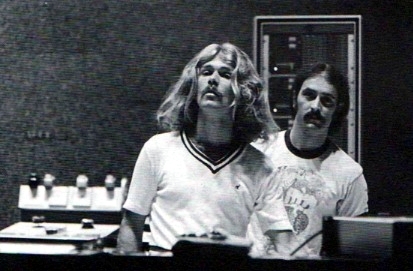
And this was a band – not just the Maels plus backing musicians as was later the case. Harley confirms it was very different to the Maels’ later modus operandi: ‘It was completely different. If anybody was personally controlling it would have been Earle, not Ron and Russell. It would be unusual for either Ron or Russell to tell me, ‘Don’t play that, play this’, but I remember Earle doing that a lot. Earle and Larry (DuPont), they were the recording people. Ron and Russ weren’t involved in that.’
The album again sees James playing some lead parts. Harley weighs up the two brothers: ‘Earle’s a good guitar player but Jim was more technically proficient. Earle probably played the more unusual parts.’ James’ melodic bass playing is one of the album’s highlights, though he typically plays it down: ‘I think it shows I was really cut out to be a lead guitar player. As a bass player you’re not supposed to be playing lead melodies. However, I did wanna be heard. Nobody was slapping me down so I continued to play in that overt manner.’
Harley’s drums have even more presence this time. He says that, ‘As far as my playing was concerned I had definitely progressed. I had switched from single pedal to a double pedal – double bass drums – and it had some effect.’ It most certainly did!
Russell sings better than on the debut, though still not to everyone’s taste. James says: ‘He was aware that with a voice like that commercial success may be unobtainable. All my friends would say what the heck is going on with this guy. There was enough for me going on musically that I never thought about it that much. It turns out over the years he has been highly emulated. He has been influential and true to himself.’
Todd Rundgren wasn’t sure about the results when Lowe played them to him. He thought they had strayed too far into normality, but really it’s merely the musical backdrop that has tightened up. There is still room for some deviations from the more cohesive style – Here Comes Bob, The Louvre, Angus Desire and Batteries Not Included all shift the sonic template. The songs’ formats and construction were largely down to the band with Lowe ‘suggesting emphasis was put in different places, and of course the sound of the record.’
Ron handles the lion’s share of the writing as he did on Sparks. It’s another hugely diverse set of lyrics and melodies that still reveal little or nothing about their writer. James can’t add much about him either: ‘Ron is a very intellectual guy. Whenever the topic would start to get emotional and personal he would move right away. He didn’t want anything to do with that stuff. I never saw him get close to a woman, or even a man. He was a tall good looking guy. He could probably have pulled the chicks with no problem, but I guess he was just born that way.’
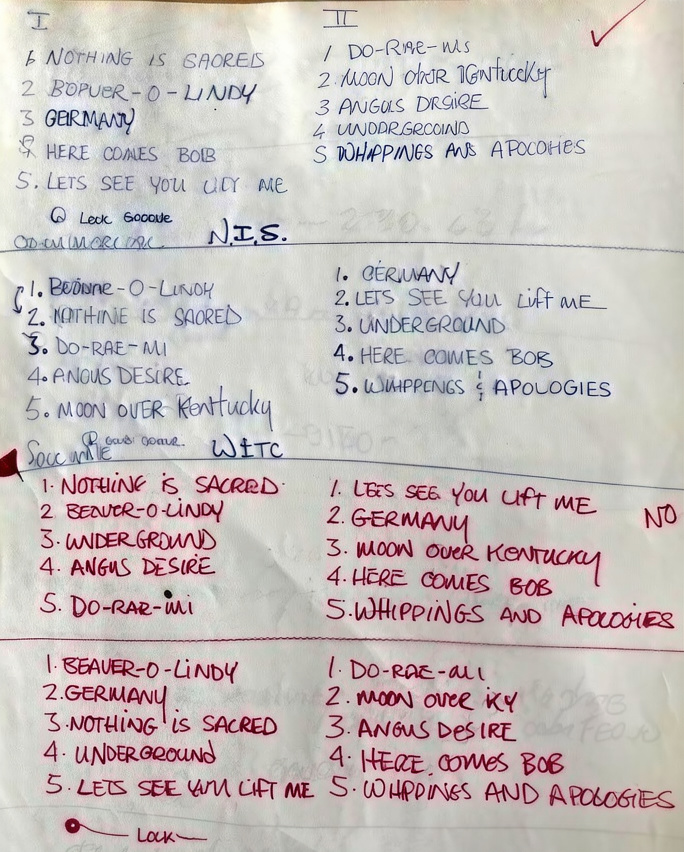
The album’s running order, oddly enough, was chosen by James Lowe: ‘That was the order I put everything in. I gave it to them and it came back the same. They were always respectful and would ask what do you think?’ Lowe played around with different sequences, as can be seen below.
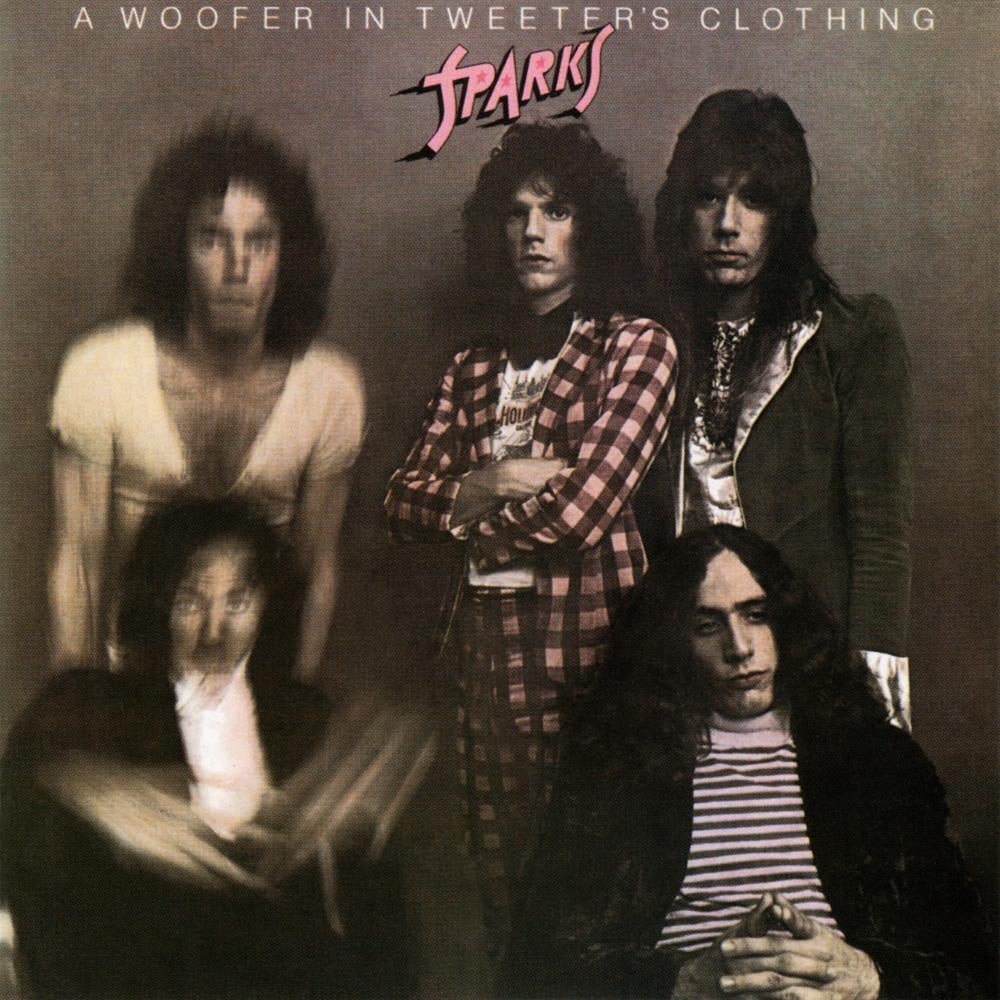
For the sleeve, the band and Larry Dupont went to UCLA’s Ethnic Arts Museum. While the back three are all engaging directly with the camera, Ron and James are not. Ron is apparently indifferent while James looks like he would rather be somewhere else. This is what was originally the back cover, because the chosen front cover was an outtake. While DuPont was taking the shots, Harley pulled Ron’s chair from underneath him. When the band saw the image they picked it out for the front cover. The only other thing to change was Russell’s suit, which he asked DuPont to colorise. His red and black checked suit became a green and black version for the rear cover. The movement of Ron falling backwards is the main difference between the front and back covers. Over the decades, and particularly in the CD age, the rear cover became the front – that blurring image being consigned to the rear instead. Both shots have a mysterious dark feel that suits the music. Ron’s necklace is the only frivolity here, a Beatles’ Yellow Submarine design.
A radio ad was made for the album using Batteries Not Included. Lowe recalls that, ‘Somebody in the studio said what we need on this is a kid. So Earle Mankey goes down on the street in Hollywood and ten minutes later comes back with a kid and his mother. This was just for the radio ad and the kid nailed the thing in one take. He did the ‘Hey kid’ part.’ That unknown youngster earned himself $100 for his performance.
An important point about the album is the problem with the CD reissues. Originally it came out on one disc along with the debut album, which made sense. Sadly to get all the tracks on the disc the company resorted to speeding up side two of Woofer so that all the tracks would fit. That master has been reused for several releases. The last four tracks are increasingly affected as follows:- The Louvre is 4:52 when it should be 5:06, Underground is 2:55 when it should be 3:01, Batteries is 0:44 when it should be 0:48, and the worst affected is Whippings And Apologies which is 4:42 when it should be 5:04. On the latter Russell sounds like he is on helium on the sped up version! So check the track times on any versions you might have. If in doubt go to Youtube and look for speed-corrected versions.
Let’s look at the tracks on the album. It opens with the single Girl From Germany. Ron recalled, ‘(Russell) wrote the music. Girl From Germany was just a title, and one thing led to another. I really like the lyrics. I remember just laying on a bed and writing that one (Profile liner notes).’ Harley is not so impressed: ‘Musically it’s very good, but lyrically it’s one of the stupidest songs I have ever heard.’
It opens with a confident musical swagger. It’s a band at the peak of their powers, knowing they have something special. And Russell, especially, is on masterful form. The jaunty rhythm and melody juxtaposes against the angst in the song, ‘How I wish my folks were gracious hosts and not dismayed’. Russell outlines the faux-pas of bringing home a German girlfriend to a family who are still mindful of WW2. Earle plays shards of slashing guitar for emphasis at certain points. The chorus achieves balance with positive points about the girl and a brighter mood in the backing track.
The middle eight (2:22) is essentially a travel postcard as Russell warmly declaims Germany’s virtues, ‘with its splendid castles and fine cuisine, its lovely German women and its wonderful rivers that do flow from her hills.’ The breezy instrumental backing sells the idyllic scene too.
Another aspect of the arrangement that sticks out is the whistling, which, surprisingly, works well. James dryly recalls: ‘The fact is I cannot actually whistle, but I was standing in the crowd for that because we needed even second rate whistlers like myself.’ This great song survived in the live set into the Island years (from 1974).
Harley recalls that Beaver O’ Lindy was originally ‘developed as a theatrical song, a teensy bit of rock opera where Russell was gonna assume a character like Ziggy Stardust. When we first began to play the song we would kind of narrate a little bit about the emergence of this ‘being’ named Beaver O’ Lindy. That was the basic concept.’
In the 2 Originals liner notes. Ron said it was, ‘. . .so fragmented that it holds together. Russell added that, ‘I wrote the music to the choruses (the B-E-A-V-E-R etc. part). Ron wrote all the other bits.’ Also credited as writers are the Mankeys and Harley. The latter explains that, ‘We always wrote our own parts. A lot of people speculate that maybe Ron was the boss and he told everybody what to do, but far from it. Ron was the most open accepting supportive musician I ever worked with. Whatever I would do Ron always backed me up, ‘Yeah that sounds good, do that’. He was not dictatorial at all. People who characterise Ron as that way are completely wrong. Ron probably wrote it, but when it came time to register the copyright he also put our names on it as a magnanimous gift.’
Russell’s vocal on the line in the intro which begins, ‘They say my voice is going to change’, is enthralling and loaded with tension helped by Lowe’s clever miking: ‘That’s a 405-Sennheiser microphone with some emphasis on the word ‘cracks’ a little bit.’ Harley’s drum roll after the intro is an explosive surprise, about which he modestly says, ‘I just threw that in.’ The gang style chorus spelling out the title is effective. Lowe explains that: ‘We Cooper Time-cubed (a delay unit) all those voices and everything so it sounded like a big crowd of people in there.’
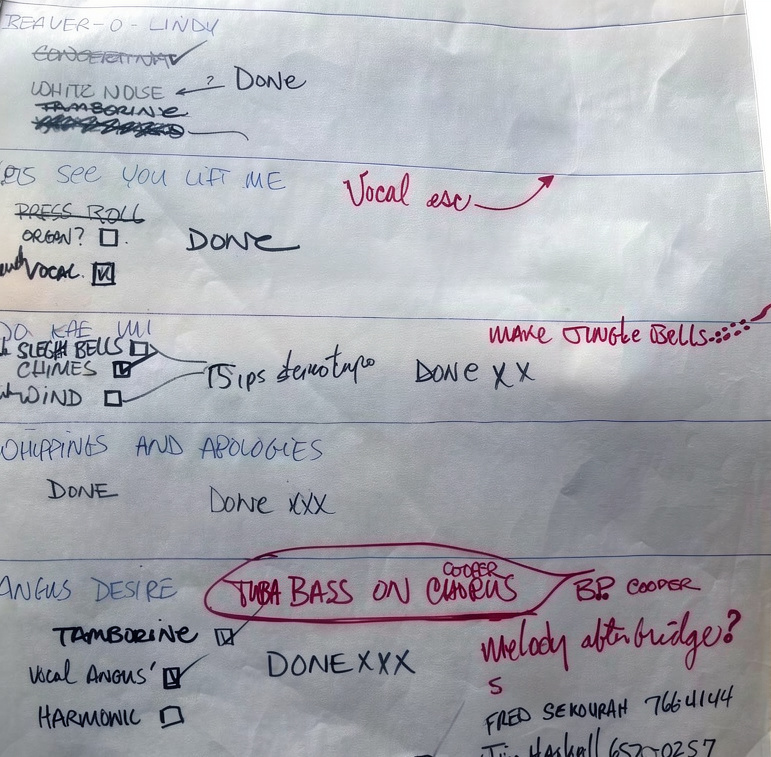
The pipe-organ on the verses was one of James Lowe’s ideas. It was recorded as an overdub by Ron at Whitney Studios (Los Angeles) while he was there primarily for Moon Over Kentucky. Not content with just the pipe-organ for Beaver they wanted something else. Lowe recalls, ‘They said do you know anybody who plays the accordion? Kip Tulin, my bass player Mark’s little brother, played the accordion so we had him come down and put some accordion on there.’ Kip was a mere 14 years old at the time and turned in an accomplished performance.
Band aid Joseph Fleury added an intriguing extra detail to Sparks’ biographer Dave Thompson: ‘Alice Cooper originally contacted us to ask if they could borrow a lyric from Beaver O’ Lindy – ‘I’m the girl in your head, and the boy in your bed.’ We politely declined and the next thing we knew they had taken the title from No More Mr. Nice Guys (from the debut album) without even asking.’
Lowe likes Nothing Is Sacred a lot, ‘because it was so Sparks. I played that for Todd and he said, ‘How did you get that bass sound?’ I was always miking it directly and then running it through the console, running it through something else. I like the bass on that one a lot. I was surprised that nobody picked up on that song because I thought it was pretty cool.’ The bass is indeed fantastic – wonderful work from James. Typically he downplays the compliments: ‘Well that sounds like I should be given an A for my performance!’ Regarding the lyrics James feels that ‘Ron had not yet learned to hide all his feelings yet. By the time he got to England he had.’
A slow seductive beat from Harley opens it with a finger-wagging vocal from Russell. Earle’s guitar is an exotic pleasure when it comes in over that hell-deep bass rumble from James. On it goes with Russell intoning a somewhat lightweight set of lyrics. It’s the music that saves this one. The gang vocal on the ‘leisure time’ line is great fun. Harley says: ‘That was probably all of us plus any young ladies that happened to be in the studio at the time.’
The instrumental section (3:36) is also really good, led by James’s bass with cool guitar licks from Earle and strident simple piano from Ron. Then there’s that extended rave-up ending (4:03). It sees Russell giving his falsetto a major work-out while the band play frantically on, while also speeding up, largely led by Harley. The outro still amuses Lowe: ‘Yeah it did go on didn’t it’, he laughs. ‘You have to let these things play out as long as the band wanted to do it. I didn’t shorten anything, or lengthen it, or make any edits in their stuff because they seemed to know how long they wanted it to go on.’
In the 2 Originals notes Russell observes that Here Comes Bob features the ‘first use of outside instruments on a Sparks song. It still doesn’t sound like a real song.’ Ron adds that it was ‘the tale of the best way to meet people in Los Angeles, that is, smash your fender into their fender.’
This was also the first example of the Maels branching out on their own. Harley recalls that, ‘I wasn’t there; it’s basically Russell with Ron on the piano.’ Plus a string quartet! Lowe sorted out their booking: ‘The string quartet session was at Crystal Sound Studios (in Los Angeles). The song sounded so formal and I thought that kind of stuff went with it. We just got a group of studio guys. You get a violinist and he recommends a cellist and so on. I asked them (Ron and Russell) if they wanted to do the arrangement and they said, ‘No, why don’t you get somebody’, so I got Jules Vogel. He was the son of another engineer who said, ‘My son does arrangements’, so I listened to some stuff and said, ‘Great, you’re on.’
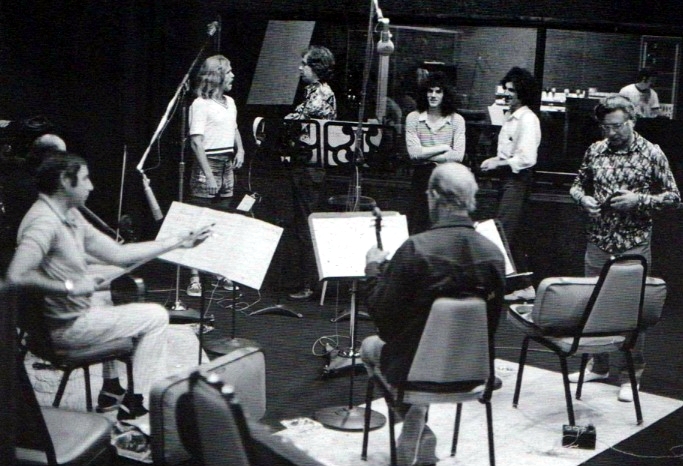
Vogel’s arrangement is based on the melody line but takes off on different tangents. It’s a delightfully playful, lively arrangement, augmented by Ron’s piano which holds down the rhythm. ‘Whimsical that’s what we call it’, says Lowe. ‘He did a good job and it’s funny because I don’t know why we didn’t credit him on the album. But I didn’t have much to do with the liner notes or anything.’
It’s barely over two minutes long but the song is certainly not filler. Russell’s voice is intriguingly deadpan and naieve at times. He sounds like an innocent troubled soul, as befits the lyrics. Ron’s accompanying piano part is perfectly judged and weighted. It’s an amusing but melancholic and quite intriguing little song.
Did the rest of the band mind not being on the track? James says, ‘No, whatever works is fine. Our egos were not yet so bruised that we worried about that kind of thing. We played some kind of reference track but by the time the string arrangement was done we were all gone.’ I wonder what happened to the reference track?!
Russell was unimpressed by James’ lyrics for Moon Over Kentucky : ‘The echo on the voice of this one more than compensates for the shallow lyrical content’, he said in the 2 Originals notes. Harley, though, remains a big fan of the song: ‘A really good one, My recollection is Jim was the one who brought that song to us.’ It’s a vague memory now for James who admits, ‘I had some kind of input on the words and it hardly sounds like something Ron would write. That was a song I felt a personal affinity with.’
Immediately from the scene-setting instrumental intro the Hollywood influences are clear. Ron commented: ‘I wrote the intro theme after seeing Death In Venice the previous day (2 Originals notes).’ That doesn’t surprise James who recalls that, ‘Ron was a cinema/ arts major – everything was a movie to him.’
It has a mood and cinematic quality, with a sense of foreboding and impending doom. Russell sounds on the edge of sanity, though his own backing lahs give a soft moody tone to offset that. The band, for their part, are absolutely magnificent. James recalls: ‘We got in the studio and got all the production going and the song seemed to go somewhere all on its own. It was a surprising event. And we said, ‘Hey that worked out OK didn’t it?’’ It features James’ stellar lead guitar, with him confirming, ‘That’s my riff. It’s me playing guitar on the Japanese Sunset 12-string.’
The outro is just stunning, a hypnotic rhythm and some overdubbed Phantom Of The Opera style organ that just oozes menace. Russell’s scat style vocals riff over the top like a cabaret singer losing his mind. Lowe loves the outro too: ‘That’s kind of a spooky one. It could be in like a horror movie. We rented Whitney with their big pipe organ for that. A whole room in the studio is built around that pipe organ. It’s a great instrument, the Beach Boys used to use it a lot. Russ came in too for that recording.’ This is one of their best songs full-stop. A stunning piece of work from all involved, especially James and Russell.
The original Sparks band played a few covers live in their time but only Do-Re-Mi made it to an album. Ron recalled: ‘This developed from one of our infrequent jam sessions. A crowd pleaser, but hard on the pocket book since it was written by a couple of other guys (2 Originals notes).’
Lowe was initially amazed at the choice: ‘I couldn’t believe we were doing that when we did it. We never talked about the songs or the intros, or what it was going to be, we just started working on them. That particular one I knew the song we were doing but it came out different to what I expected!’
In The Sound Of Music it was twee, but you couldn’t argue with the simple joy of it. What Sparks did was to retain the feel-good nature, up the tempo and let it loose and hammer at you till you have to give in to it! It’s more than a cover version, they own it. It had always been a highpoint of their live shows, hence its inclusion on the album, and they manage to get an exuberant live feel on this version.
It opens very quietly with wind noises, which surprised Harley: ‘I would kind of come and go and do my parts. I missed out on a lot of the overdubs so that the wind on Do-Re-Mi came as a surprise.’ The first highlight though is Ron’s descending organ part (0:49) which becomes a feature of the song. In itself that part is instant joy. Matching Ron for joy is Russell who is clearly having a great time, and you can tell how much effort it is to deliver the song.
Harley’s turnaround at 1:09 kickstarts the faster middle section with Russell sounding like he is clinging on till the end of his lines. The band are on fire with Harley and James in particularly outstanding form, locked in tight. Russell’s ‘Oh Yeah’ at 1:59 cues up the magical final part.
Ron now sticks to a sweet melody over the relentless rhythm section which also includes Earle. The explosive release of Harley’s drums at 2:09 is simply joyous. I still to this day remain astonished at how they keep that rhythm going. Lowe laughs: ‘I have no idea how (Harley) hit any of the marks or anything. It’s like a guy who fell of the back of the train and he’s trying to catch up the whole time.’ Harley modestly says that, ‘My part isn’t particularly difficult. I was just playing single stroke rolls and emphasizing some of the beats. But it fitted in well with what Jim was playing. That bass part is really fast and perfectly in sync, not many people could do that.’ James laughs and shrugs it off with ‘we were very young and energetic at the time.’
Ron’s increasingly strong keyboard swells up over the barnstorming attack to lead the band into a return to the musical melody for a finale. Harley and James are still on full-turbo mode and it culminates in what sounds like tubular bells and church bells (probably played by Ron says Harley). ‘It’s crazy how they all ended together’, says Lowe who, like me, still thinks they won’t make it to the end of the song even after decades of listening to it! A truly wonderful performance.
Russell proudly claims in the 2 Originals notes that Angus Desire is ‘one of the best titles in the history of Western music.’ In the same source Ron added, ‘Title inspired by Dean Detrick Jr. Blame him, not us.’
Dean Detrick is an artist and designer who studied fine/ studio arts at UCLA from 1964- 1974. He told me: ‘I have known Ron and Russell since about 1958. Angus Desire was a song title I came up with during one of our music listening sessions. We would try to out-do each other with unusual names for songs. The title is just two words that rolled off the top of my head. I wasn’t thinking of anything when I said it. The uneasy feeling of the song is appropriate since someone who has ‘angus desire’ would be considered undesirable. Angus is a breed of cow. Angus is also a man’s name which would be a different story. I wonder if Sparks might have woven these two topics together in one song?’
The opening lines, ‘See private parts, in public school. They look so odd, try something else’ suggest someone having problems with aspects of life-drawing! ‘That does sound like a life drawing/painting class’, agrees Detrick. Harley sanguinely sees it more as evidence that, ‘Ron hadn’t really perfected his ability as a lyricist yet during that earlier era.’
There is a creepy edge to this song. It feels like you have just discovered something seedy or repugnant but curiously fascinating, except, apparently, to James Lowe’s mother: ‘That’s one of the ones my mom didn’t like. She didn’t know what it meant but she didn’t like it.’ Lowe himself does like it a lot and loves ‘that low growling keyboard.’
The uneasiness is there right from the opening lines with Russell’s furtive almost gleeful vocals and an ominous organ part from Ron. The distant backing vocal adds to the sense of something eerie going on. Harley remembers that, ‘the idea for the drum part was from Instant Kharma (by John Lennon). That was what I was playing, basically a double bass drum shuffle. But now when I listen to it I don’t even hear the bass drum, it got mixed out.’
It shifts into a laid back claustrophobic feel with Earle’s softly played acoustic and Ron’s organ. The big harmony part, ‘Angus, oh Angus’ takes things to new levels of weirdness, with Ron’s quavering sounds. This great song comes in and occupies your living space in a compelling, uncomfortable way.
Russell tartly observes in the2 Originals notes that Underground was, ‘Earle’s first smash since ‘Biology 2’. I think I prefer songs about microscopic organisms.’ What is odd then is that it’s Russell who sings it. Harley observes that, ‘It sounds very different to the others.’ It is too as it features more straight forward pop sensibilities than the rest of the album, making for an interesting diversion. James likes it: ‘That was a really good song. Now there’s your single!’
It opens with a staccato organ part from Ron with great backing from Earle, Jim and Harley. They keep up a great groove throughout the song with no real solos. The intro leads straight into the chorus which vocally is a treat with the great backing harmonies. The verses are strong too with a nice mood to them from Ron and Earle. The section ‘Oh Lord we gained our world distribution by relevant means’ changes the tempo cleverly with Ron playing some wild fast keyboards. It’s a strong song with an interesting construction and tone that has not been given enough credit.
Lowe’s possible running orders for the album all note The Louvre as being called Let’s See You Lift Me. ‘I love that one, says Lowe, ‘I thought that was elegant.’ Ron plays what is always thought to be a harpsichord on the song but, ‘it’s actually a grand piano’, reveals Lowe. ‘I ran it through a limiter and stuff and squeezed the crap out of it. If you don’t have a harpsichord there it’s an expedient solution.’
Lyrically this is another strange one. James playfully opines that, ‘You don’t want to delve too deeply into the workings of his (Ron’s) mind. I mean listen to those lyrics, are those not the lyrics of an anti-social potential murderer maybe?’
The original idea was for Russell to sing the whole song in French. Friend of the band Josee Becker did the translation but after some thought it was decided to follow the French lyrics with Russell singing in English. It’s clever, and not particularly apparent at first, that it’s the same words. Of course this also has the effect of doubling the song’s length.
Ron’s ‘harpsichord’ opens and it’s obvious where we are located right away. Lovely bass playing from James follows in which he sounds like he is preparing for La Marseillaise. As we are in The Louvre Russell adopts a quiet respectful vocal. It’s a beautiful piece of work that in the high tempo sections is in keeping with what is to come on Kimono. The bridge is just wild – going from a heavy rock feel (Earle needed turning up here) into a musical scat-singing section.
The second half sees Russell swap to English. The effect is dazzling with a bigger and brighter sound as we approach the final denouement. The statue, ‘a monument to change’, is alive. It’s eyes ‘fixed upon the door’. A splendid piece of inventive work.
Batteries Not Included was clearly an afterthought as it’s not listed on potential running orders. James says that, ‘We had a demo taped that Earle had recorded and we all had quarter-inch copies of it. It’s very literary, there’s a novel in there somewhere. It was a joke obviously, you could even say it was a throwaway tune!’ It may be brief but it is great fun and stands up well even after years of playing it.
One thing they should have changed was the title, because it reveals the final pay-off before you get there. This matters not to fans who have heard it ad-infinitum, but first time round it would have been great to get to the end and have your suspicions confirmed, without the title making it obvious what the problem is.
That being said this is a clever piece of work that raises a smile. What the character in the song bought is never stated, and it’s quite delicious how his pleasure turns to fury as he realises what is missing. Why doesn’t he go out and buy some batteries, or wait until the next day if the shops are closed? Well sometimes you just react instantly I guess.
The conspiratorial tone from Russell is a treat as is Ron’s playful piano accompaniment. When Russell reaches the ‘Hey kid’ denouement there’s a huge instrumental swell in the background from Ron’s piano, but that’s not all. Harley reveals: ‘There’s also a symphony orchestra which was sampled without authorisation, I remember James Lowe saying, ‘Hey, let’s just steal this part from this record’. I don’t remember which record and I’m sure he doesn’t either.’ He doesn’t!
Russell tackled the title of Whippings And Apologies in the 2 Originals notes: ‘Always misconstrued to be about some perverse going on, when in fact it was about spankings at home.’
‘That one knocks me out’, says Lowe. ‘It’s a real power piece.’ When they wanted to, this incarnation of Sparks could seriously rock out. That ‘Marlene Dietrich meets The Stooges’ analogy from a Trouser Press article firmly applies to Woofer‘s final track. James affirms: ‘They certainly seemed to have some connection with Germany – Lotte Lenya. They were definitely into that kind of literature and music. It wouldn’t surprise me if Ron had steeped himself in some Bertolt Brecht music before coming to put that song down. It’s just the kind of thing he would have done.’
Harley says that, ‘When we recorded it and live, Ron would handle the bass part on his keyboard.’ Doing so freed up James to play lead and rhythm guitar along with Earle. The duo are absolutely on fire on this one.
The intro wailing guitar is by Earle over what Lowe reveals is a, ‘keyboard, maybe a clavinet or clavichord, alternating between the higher note and the low tone’. From then on it’s Earle and James on rhythm and duelling leads, which gives the song so much excitement and intensity, with Ron handling the bottom end. The song sees the third appearance of outside players. ‘I brought in some French Horn players’, says Lowe. These were also recorded at Crystal Sound Studios and can be heard at 2:47 (on the correct speed version).
The song is terrific with sharp mannered disdainful vocals from Russell. But it’s the long run to the outro from 3:50 (correct speed) that stuns. James on lead and Earle on rhythm tearing it up. A great way to finish the album.
Lowe remains proud of Woofer: ‘I thought it was a cool album. I remember walking away from it and thinking that’s as good as I can do it. I thought it was confident and had fire in it. It had some really good cuts in there. Moon Over Kentucky and some of those things are great. If I was going to see them live I would ask the band to play them!’
Woofer remains my favourite Sparks album. It didn’t chart anywhere but it’s got terrific songs on it with the band at their best. They, and the songs, are bigger, darker, engrossing, more absorbing, more enthralling and somehow even more eccentric than on their debut. There are plenty of other great Sparks albums but this collection of curios calls me back again more than any of the others.
This piece is edited from my book Sparks : 1969 – 1979. Thanks to Harley Feinstein, James Mankey, Dean Detrick and James Lowe (R.I.P.) for their time and thoughts.